
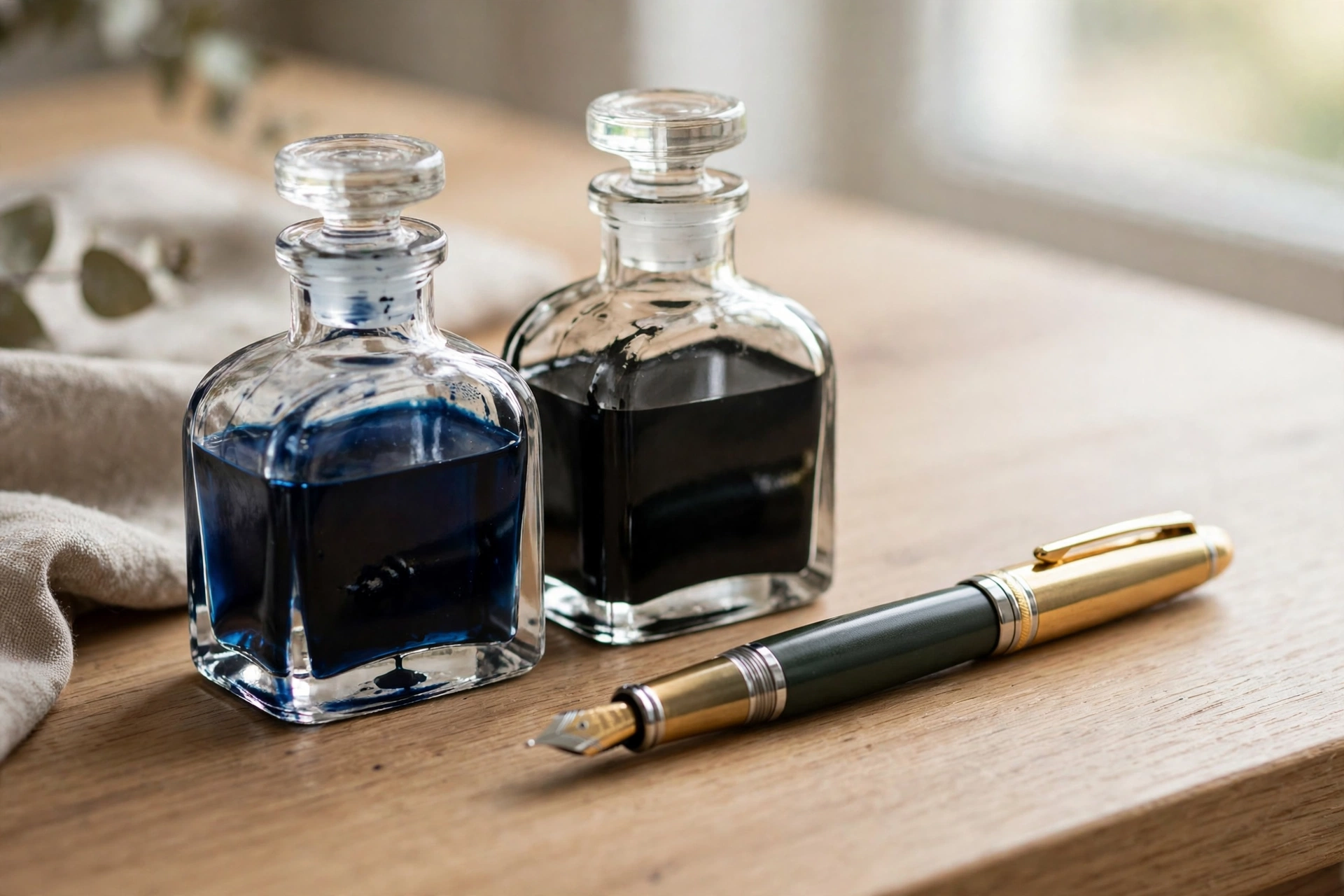
How is ink made? At its simplest, ink is a colour held in a liquid that can be transferred to paper or another surface and stay there. The details vary enormously between a fountain pen, a ballpoint, a printing press and an inkjet printer, but every ink answers the same four questions: what gives it colour, what carries that colour, what makes it stick, and how does it dry or set?
The four basic ingredients
Most inks, old and new, are built from the same kinds of ingredients.
Colourant. This is either a pigment or a dye. A pigment is a tiny solid particle that sits on the surface, like coloured dust. A dye dissolves fully in the liquid, like sugar in tea. Pigment inks are usually more resistant to light and water, while dye inks often give brighter, smoother colour.
Vehicle or carrier. This is the liquid that carries the colourant and controls how the ink flows. It usually contains resins, solvents and additives, and it is chosen to suit the pen, press or printer it is made for.
Binder or resin. The binder holds the colour particles together and helps them grip the surface after the liquid part has dried or soaked away. Without it, ink would dust off the page.
Additives. Small amounts of other ingredients adjust drying time, thickness, flow, resistance to smudging and stability in storage. They are a small part of the recipe, but they decide whether an ink writes smoothly or clogs, feathers or fades.
A short history: ink before factories
Ink is far older than printing. Early inks were made from materials people could find nearby: soot collected from burning oil or wood, mixed with water and a binder such as animal glue. In East Asia, solid ink sticks were made by kneading soot with dissolved glue, adding a fragrance to mask the smell of the glue, then moulding and drying the mixture in wooden moulds. The user ground the stick with water when ink was needed.
In Europe, iron gall ink was dominant for centuries. It was made from iron salts and tannic acids from oak galls, and it darkened as it reacted on the page. Sepia ink came from the ink sacs of cuttlefish, and plant-based inks were made from berries, bark and other organic materials. Different regions used different recipes, but they shared the same structure: a colourant, a binder and a carrier liquid.
How modern ink is manufactured
Modern ink manufacturing follows a clear sequence, even though the exact recipe changes for each use.
1. Choose and prepare the raw materials. Pigments, resins, solvents and additives are selected for the intended use. A fountain pen ink needs to flow freely and not clog a narrow nib. A printing ink needs to transfer cleanly from rollers to paper at speed. An inkjet ink needs to fire through tiny nozzles without blocking them.
2. Disperse the pigment. Pigments are mixed into the liquid with high-shear mixers, which wet the pigment surface and break apart clumps. This pre-dispersion step matters: if the pigment is unevenly wetted at this stage, later grinding cannot fully fix it.
3. Mill the mixture. The mixture is passed through mills, such as bead mills filled with tiny ceramic beads or three-roll mills, to grind the pigment to a fine, even particle size. For inkjet inks, the target can be below 200 nanometres, and operators check particle size regularly during milling. The finer and more even the particles, the smoother the ink and the less likely it is to clog.
4. Filter and degas. After milling, the ink is filtered, sometimes down to about half a micron for inkjet ink, to remove any oversized particles. Dissolved air is also removed, because bubbles would cause missing drops in a printhead.
5. Test the batch. Colour, thickness, drying time, surface tension and pH are checked, and inkjet batches are also tested on a printhead simulator, where the ink must fire thousands of drops without a missing nozzle. Some batches go through accelerated ageing at raised temperatures to predict shelf life.
6. Fill and package. Only batches that pass are filled into bottles, cartridges or bulk containers, usually with a batch or lot number so any later problem can be traced. Packaging also matters: airtight containers protect ink from contamination and from drying out or changing in storage.
Why pen inks are not all the same
A fountain pen ink is mostly water-based, with dye or fine pigment, and it flows by capillary action through the nib. It must be thin enough to flow, but not so thin that it bleeds through ordinary paper. Ballpoint ink is much thicker, almost paste-like, and is transferred by the rolling ball at the tip. Gel ink sits between the two: it is water-based but thicker than fountain pen ink, which is why gel pens often write smoothly and give strong colour. Marker and whiteboard inks are different again, because they must dry quickly on a non-absorbent surface and, for whiteboard ink, wipe off cleanly afterwards.
The same ink will also behave differently on different papers. Smooth, coated paper keeps ink on the surface, giving sharper lines and stronger colour. Absorbent, uncoated paper soaks ink in, which can soften lines and cause feathering. This is one reason a pen that writes beautifully in one notebook can look different in another, and why typography and paper choices matter for how printed text looks on the page.
Printing ink versus writing ink
Printing inks are made for speed and for transfer, not for a pen nib. Offset printing ink is thick and tacky, so it can be rolled evenly and transferred from plate to blanket to paper without spreading. Flexographic and gravure inks are thinner, because they are used on packaging, films and other surfaces at very high speeds. Digital printing and inkjet inks are the thinnest of all, because they must pass through microscopic nozzles.
Colour is also handled differently in printing. Home and office printers usually mix cyan, magenta, yellow and black, while commercial printing may use additional spot colours for an exact brand shade. The ink itself is only part of the system: the printer, the paper and the drying or curing method all affect the final result.
What makes ink permanent — or not
“Permanent” on an ink label usually means resistant to water, light or fading under normal use, not indestructible. Pigment inks tend to last longer than dye inks because solid particles are less easily washed away or broken down by light. Iron gall ink, for all its historical importance, could damage paper over long periods because of its chemistry, which is one reason archives handle old manuscripts with care.
For everyday use, the practical lesson is simple: if a document must last, use a pigment-based ink on good paper and store it away from damp and direct sunlight. If colour brightness matters more than longevity, a dye-based ink is often the better choice.
Ink in everyday life
Ink is easy to overlook because it works quietly. It is in school pens and art supplies — see our school supplies list for the basics — and in the paints and markers used for kids’ crafts at home. It is also in packaging, labels, newspapers, banknotes and barcodes, each with a recipe tuned to its surface and its job. The ink in a banknote, for example, must resist copying and wear, while the ink on a food package must be safe for its intended use and stay legible through handling and storage.
Frequently asked questions
What is ink made of?
In general, a colourant (pigment or dye), a carrier liquid, a binder or resin, and small amounts of additives that control flow, drying and stability.
Is ink a liquid or a solid?
Most ink is sold as a liquid, but some forms, such as traditional solid ink sticks and dry toner for laser printing, start as solids and are turned into marks by grinding with water or by heat.
Why does printer ink cost so much?
Printer ink is not just coloured water. It is milled to extremely fine particle sizes, filtered, tested for printhead reliability, and sold in small cartridges with a large share of the cost in research, testing and packaging rather than raw materials alone.
Can you make ink at home?
Simple plant-based inks can be made for craft use, but homemade ink is not a substitute for commercial pen or printer ink. It can stain, clog pens and printers, and fade quickly, and it should never be used in a printer.
For a fuller look at the history and modern process, see Gamut Packaging’s guide to the origins and composition of ink and Shoyu Net’s guide to ink raw materials and types.
The next time a pen glides across a page or a printer produces a sharp photograph, it is worth remembering how much work sits behind that small mark: colour ground finer than a speck of dust, carried in a liquid tuned to flow exactly as needed, and tested until it can be trusted to behave the same way, drop after drop.