
Direct answer
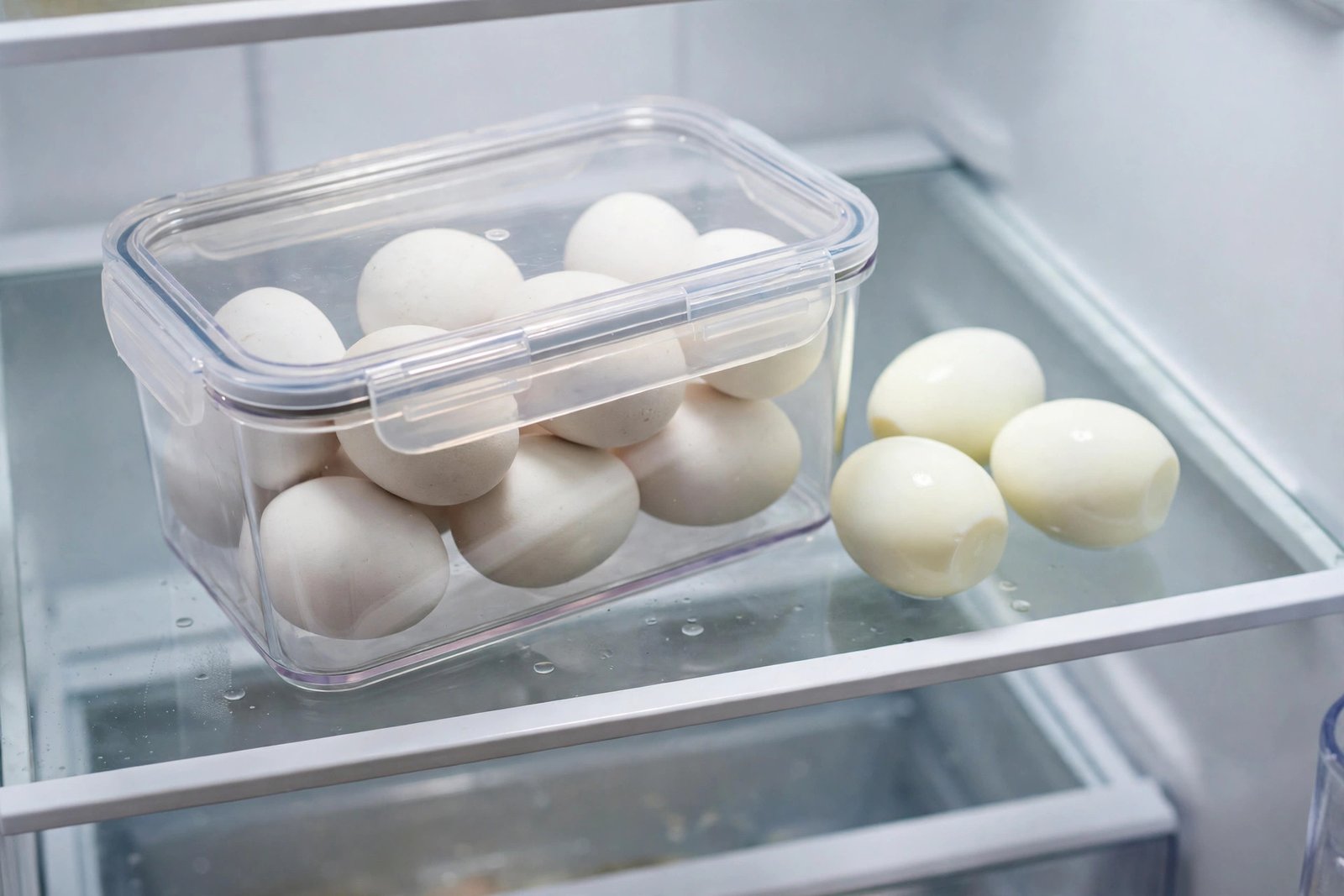
Most cooked eggs last 3 to 4 days in the fridge when they are cooled quickly and stored at or below 40°F (4°C) in a sealed container. Hard-boiled eggs are the main exception: with the shell still on, they can last up to 7 days under the same cold conditions, according to United States food-safety guidance. Once peeled, hard-boiled eggs are best used within 3 to 4 days, because the shell is no longer protecting them.
That difference is the reason so much online advice looks contradictory. One source says 3 to 4 days, another says a week, and both can be right — they are talking about different kinds of cooked egg. Use the shorter window for scrambled eggs, fried eggs, egg salad and other dishes, and the longer window only for hard-boiled eggs that are still in their shells.
Why cooked eggs do not last as long as raw eggs
A raw egg in its shell can last 3 to 5 weeks in the fridge, which surprises many people. Cooking changes that. Boiling washes away the shell’s natural protective coating, called the bloom or cuticle, which normally helps seal the shell’s pores. Without it, bacteria can reach the egg more easily, and the cooked egg becomes a protein-rich food that bacteria can grow in.
Refrigeration slows that growth, but it does not stop it completely. That is why time and temperature matter together: a fridge that holds a steady 40°F or below gives you the full safe window, while a warmer fridge shortens it. The door of the fridge is the worst place to store eggs, because the temperature swings every time the door opens. Keep them on an inside shelf instead.
The 2-hour rule comes first
Before the fridge clock even starts, there is a room-temperature clock. Cooked eggs should go into the fridge within 2 hours of cooking. If the room is hot — above 90°F (32°C) — that window drops to 1 hour. Eggs left out overnight, or left on a buffet table all afternoon, should be thrown out, even if they look and smell fine. Reheating does not make them safe again, because reheating kills many bacteria but does not remove every toxin that bacteria may already have produced.
Cool eggs quickly after cooking. An ice bath after boiling helps hard-boiled eggs cool fast and makes them easier to peel. For scrambled or fried eggs, spread them in a shallow container so they cool evenly, then seal and refrigerate.
How long each type lasts
| Type of cooked egg | Fridge life at 40°F or below | Key storage note |
|---|---|---|
| Hard-boiled, shell on | Up to 7 days | Keep shells intact, store dry in a covered container |
| Hard-boiled, peeled | 3 to 4 days | Keep in a sealed container; some guides suggest covering with cold water and changing it daily, but a dry sealed container is simpler and safer for most kitchens |
| Scrambled or fried eggs | 3 to 4 days | Portion into small airtight containers so they cool fast |
| Egg salad or deviled eggs | 3 to 4 days | Mayonnaise-based dishes spoil faster; keep them cold and do not leave them out for serving for long |
| Egg casseroles or quiches | 3 to 4 days | Cool, cover tightly, and refrigerate promptly |
Count day one as the day the eggs were cooked. If you cannot remember when they went into the fridge, throw them out. A simple label with the cooking date on the container avoids that guesswork entirely, and it is the single most useful habit for meal prep.
How to store cooked eggs properly
Good storage is simple, and it makes the difference between the full safe window and a shorter one:
- Use a sealed container. An airtight container stops the eggs drying out and stops them picking up strong fridge odours from onions, garlic or leftovers nearby.
- Keep hard-boiled eggs in their shells until you need them. Peeling everything in advance saves a few seconds later and costs days of shelf life.
- Do not store them in the fridge door. Use an inside shelf, where the temperature stays steady.
- Label the container. Write the cooking date on it. If there are two batches, use the older one first.
- Do not put hot eggs straight into a sealed container in the fridge and forget about them. Let them cool to room temperature first, but within the 2-hour window, then seal and refrigerate.
The same fridge-storage thinking applies to other leftovers. For example, how long pizza is good in the fridge follows the same 3 to 4 day rule for most cooked leftovers, and the same 2-hour rule for food left out at room temperature. More cooking and kitchen storage guides are in the Cooking & Kitchen section.
Can you freeze cooked eggs?
Some cooked eggs freeze well, and some do not. Scrambled eggs, fried eggs and egg casseroles can be frozen for 1 to 2 months for best quality, in airtight freezer containers or bags with the air pressed out. Thaw them in the fridge overnight, not on the counter, and reheat until steaming hot throughout.
Hard-boiled eggs do not freeze well. The white turns rubbery and watery after thawing, so freezing is not recommended for them, even though it is technically safe if they stay frozen solid. If you have more hard-boiled eggs than you can eat in a week, the better plan is simply to boil fewer next time.
How to tell if cooked eggs have gone bad
Trust your senses, but do not rely on them alone. Bacteria can be present without any obvious smell or visible change, which is why the date matters more than a sniff test. Throw cooked eggs out if you notice any of these:
- A sour, sulphurous or unusually sharp smell, different from a normal cooked-egg smell
- A slimy texture on the egg white or yolk
- Discoloration, pink or green slime, or any mould
- A container that has been left out for more than 2 hours, or a fridge that has been off for more than 4 hours during a power cut
When in doubt, throw it out. A few eggs are never worth a stomach bug, and the risk is higher for children, pregnant women, older adults and anyone with a weakened immune system.
Using up cooked eggs before they expire
If your hard-boiled eggs are nearing the end of their window, use them in a dish that is cooked again and eaten straight away — sliced into a salad, chopped into a sandwich filling, or added to a hot noodle bowl. Do not use older eggs for a raw or lightly cooked application, and do not try to extend their life by reheating them and putting them back in the fridge. Reheat each portion only once, until steaming hot throughout.
Meal prep works best when you cook only what you will eat within the safe window. A batch of six hard-boiled eggs for the week is sensible; a batch of two dozen is usually waste, unless you are cooking for a crowd.
FAQs
Q: Can I eat cooked eggs after 5 days in the fridge?
A: For scrambled, fried or mixed egg dishes, no — stick to 3 to 4 days. For hard-boiled eggs still in their shells, up to 7 days is the guidance, but check them carefully and throw them out if anything looks or smells off.
Q: Do peeled hard-boiled eggs last as long as unpeeled ones?
A: No. Peeling removes the shell’s protection, so peeled eggs should be used within 3 to 4 days, while unpeeled eggs can last up to 7 days in the fridge.
Q: Can I eat a hard-boiled egg that was left out overnight?
A: No. More than 2 hours at room temperature means it should be discarded, even if it was refrigerated afterwards.
Q: Does the fridge temperature really matter?
A: Yes, it is the most important factor. At or below 40°F (4°C) you get the full window. Above that, bacteria grow much faster, in the danger zone between 40°F and 140°F.
Q: Can I freeze hard-boiled eggs?
A: It is not recommended. Freezing makes the whites rubbery and watery after thawing. Freeze scrambled eggs or casseroles instead, for 1 to 2 months.
Sources
- Taste of Home, How Long Do Eggs Last in the Fridge: https://www.tasteofhome.com/article/how-long-can-eggs-last-in-the-fridge/
- Mallory’s Kitchen, The Ultimate Guide: How Long Can Boiled Eggs Keep in the Refrigerator: https://malloryskitchen.com/the-ultimate-guide-how-long-can-boiled-eggs-keep-in-the-refrigerator-and-how-to-store-them-safely/