
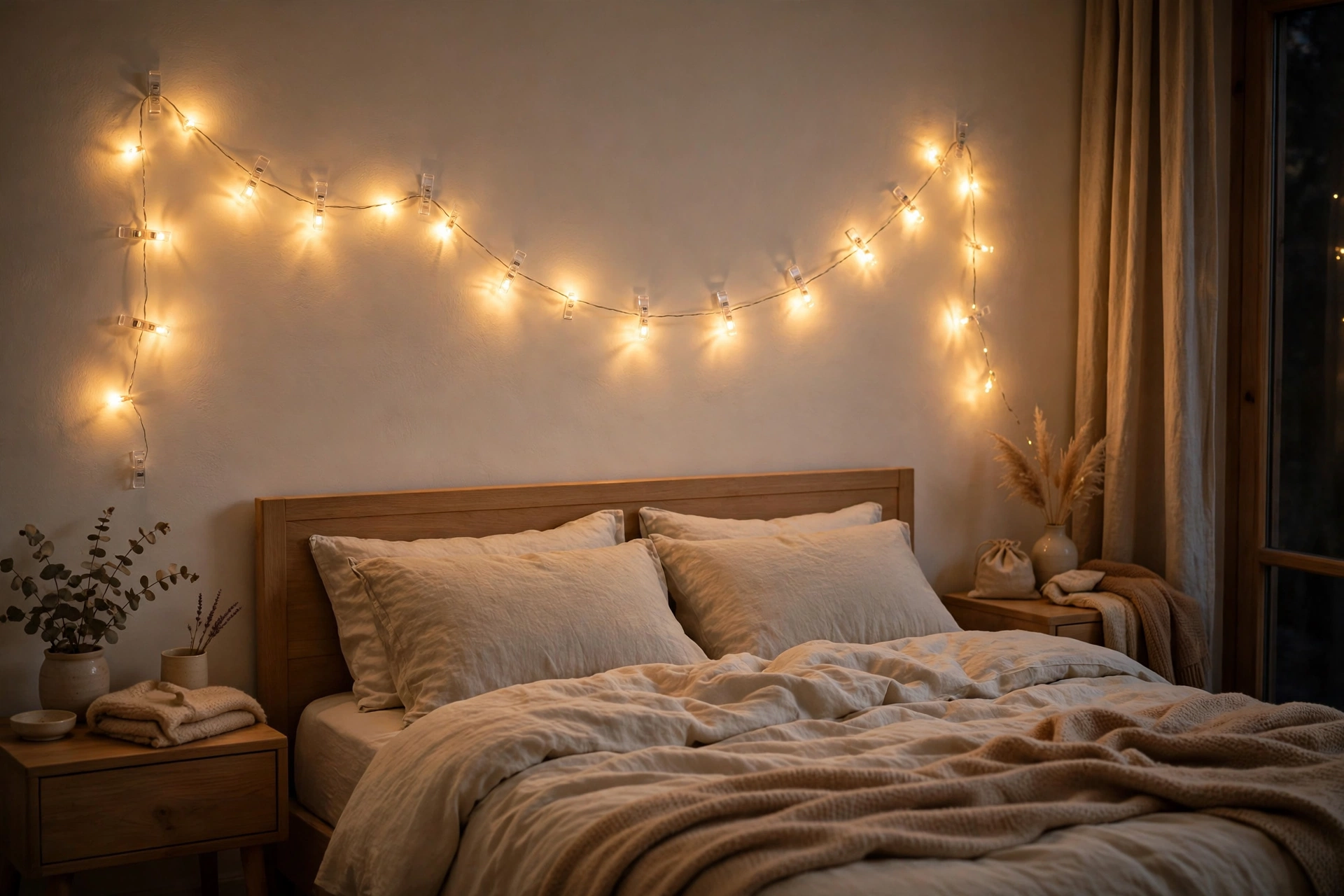
Fairy lights can turn a plain room into a warm, cosy space in an evening. The problem is not the lights. It is what holds them up. Nails leave holes, ordinary tape peels paint, and staples can damage both the wall and the cable. The good news is that fairy lights are light, so you rarely need anything permanent. With the right method for your surface, you can hang them securely and take them down cleanly.
Start before you stick anything. Plan the layout, check the surface, and work out where the power comes from. Those three steps decide whether the lights stay up and whether the wall stays intact.
Plan the layout first
Measure the wall or the path the lights will follow, and compare it with the length of the string. A string that is too short will be pulled tight, which puts strain on every hook and makes the display sag in the middle. A string that is far too long will bunch up at the end. Decide on the shape first: a straight line along a shelf, a gentle drape with even swags, a zigzag across a wall, or a frame around a mirror or headboard.
Mark the path lightly with small pieces of painter’s tape, or simply hold the string up and check the drape. Place support points every 30 to 45 centimetres for a light LED string. Wider spacing looks fine on a straight run, but drapes need closer supports so the cable does not pull free. Keep the plug or battery box near an outlet or a hidden spot behind furniture, and never run a cable across a walkway where it can be tripped over.
Choose the method for your surface
Not every wall behaves the same way, and the safest method depends on what you are sticking to.
Painted plaster or drywall: Small clear adhesive hooks or light clips designed for fairy lights are the usual choice. Look for products labelled damage-free or removable, and check the weight rating on the pack. Clean each spot with rubbing alcohol and let it dry, press the hook firmly for about thirty seconds, then wait at least an hour before hanging the lights. That waiting time lets the adhesive bond properly. When you remove them, stretch the tab slowly straight down along the wall, exactly as the instructions say. Pulling outward is what takes paint with it.
Fresh paint, wallpaper, or textured walls: Be more cautious. Adhesive can lift fresh paint and damage wallpaper, and it grips poorly on heavy texture. Test one hook in a hidden spot first, and leave it for a day before committing to a whole wall. On wallpaper, adhesive putty or clips on existing trim are often safer than hooks on the paper itself.
Tiles, glass, or smooth metal: Adhesive hooks and suction hooks both work well here, because the surface is smooth and non-porous. Clean the surface first, and avoid placing hooks where steam or heat will loosen them, such as directly above a hob.
Brick or rough surfaces indoors: Adhesive rarely holds well on rough brick. Use existing features instead, such as a shelf, a picture rail, or a curtain rod, or run the lights along a wire strung between two solid points.
Use what is already in the room
The least damaging method is often no wall fixing at all. Curtain rods, bed frames, bookshelves, picture rails, door trim, and window frames can all hold a string of lights with small clips, mini clothespins, or twist ties. Wind the lights loosely around a rod, drape them over a shelf edge, or tuck them into the gap where trim meets the wall. This approach is ideal for rented homes, dorm rooms, and seasonal displays, because nothing touches the painted wall at all.
For a ceiling effect without ceiling fixings, drape lights from a curtain rod across to a bookshelf, or run them along the top of wardrobes. The lights will read as a canopy, and you will not need a single hook in the ceiling.
Adhesive putty, clips, and tape: what works
Adhesive putty, sold as poster putty or mounting putty, works for very light strings on smooth walls and trim. Press a small ball of putty around the cable every 30 centimetres or so. It is easy to remove, but it can leave an oily mark on some paints if left for months, and it softens in heat, so keep it away from radiators and sunny windows.
Clear light clips that grip the cable, rather than the wall, spread the weight better than a single hook. Tape is the weakest choice for walls. Painter’s tape holds for a short display and removes cleanly, but ordinary sticky tape and duct tape can peel paint and leave residue. If you must use tape, use painter’s tape, replace it regularly, and never use it on wallpaper.
Power and safety
Use LED fairy lights, which run cool and use little power. That matters near curtains, bedding, and fabric, where a hot bulb would be a risk. Check that indoor lights are used indoors, and outdoor lights are rated for outdoor use if they go outside. Never staple or nail through a cable, never pinch a cable in a window or door, and never overload a single outlet with several strings and adapters.
Battery-operated lights give the most freedom, because you do not need to run a cable to an outlet at all. Put the battery box where you can reach it to switch it off, and use a timer if the set has one. For plug-in sets, secure the transformer near the outlet with a small piece of painter’s tape so it does not dangle and pull on the string.
Taking lights down without damage
Removal is where most damage happens, so take your time. Take the lights off the hooks first, so no weight is pulling on the adhesive while you remove it. For stretch-release strips, pull the tab slowly straight down along the wall, keeping it close to the surface, until the strip releases. Do not yank it. For putty, roll it off gently rather than scraping it. If a little residue remains, a soft cloth with warm water usually lifts it. Do not use a scraper on paint.
If a hook does lift a small flake of paint, note it and touch it up later rather than trying to press the flake back. Small marks are far easier to repair than a torn patch of plaster.
FAQs
What is the safest way to hang fairy lights in a rented home?
Adhesive light clips on painted walls, or clips on curtain rods, shelves, and trim, are the safest options. Always test one fixing in a hidden spot first.
How far apart should hooks be?
About every 30 to 45 centimetres for a light LED string, closer for draped shapes so the cable does not sag and pull free.
Can I use tape on walls?
Painter’s tape is acceptable for short displays. Ordinary sticky tape and duct tape can peel paint and should be avoided on walls and wallpaper.
How do I remove adhesive hooks without damage?
Remove the lights first, then stretch the tab slowly straight down along the wall, as the product instructions direct. Pulling outward is what damages paint.
A little planning makes the difference between a display that glows all season and one that falls down in a week, taking paint with it. Choose the fixing for your surface, space the supports evenly, and remove everything slowly. The wall will look just as good when the lights come down as it did before they went up.
Related reading: how to cool room, how to clean outdoor furniture, how to clean a yoga mat, Home & Garden archive. Sources: Engineer Fix on hanging fairy lights without damage, Strathalbyn Hardware on putting up fairy lights without damaging walls.