
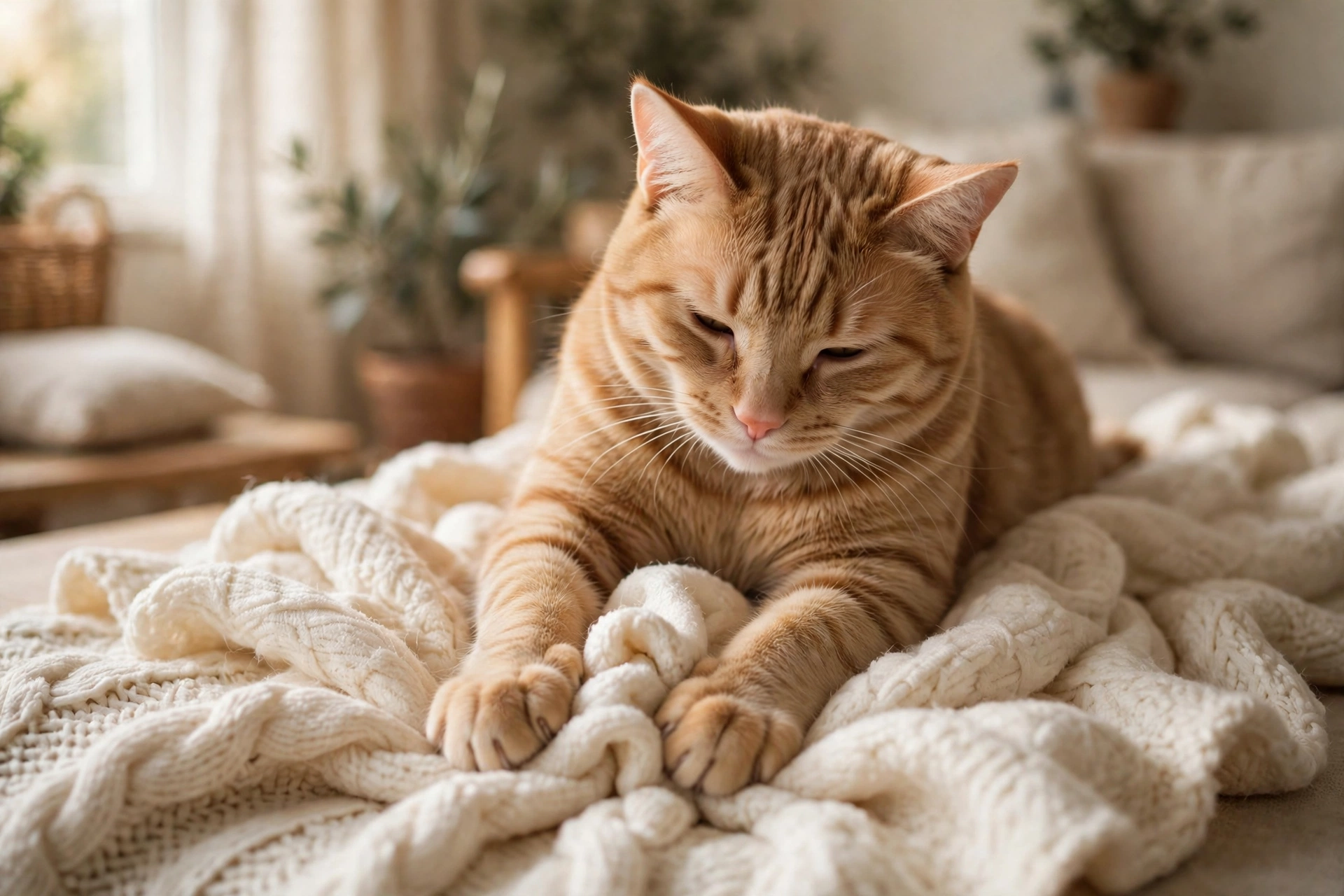
If you live with a cat, you have probably felt it: the rhythmic pressing of front paws, one after the other, into a blanket, a cushion or your lap. Cat owners call it kneading, making biscuits or baking bread, because the motion looks so much like working dough. It is one of the most endearing cat behaviours — and one of the most misunderstood.
Kneading usually means your cat feels comfortable. But it can also serve other purposes, from marking territory to preparing a resting place, and occasionally it is a way a cat soothes itself when unsettled. Understanding the reasons helps you respond well — and protect your lap from sharp claws without punishing a compliment.
What kneading looks like
Kneading is an alternating push of the front paws against a soft surface. Some cats knead gently, barely pressing; others push firmly, extend their claws with each press, and lean their whole weight into it. Many cats purr while kneading, half-close their eyes, drool slightly, or settle down for a nap afterwards. All of these are typical accompaniments.
Cats knead blankets, cushions, clothing, other cats they are friendly with, and their favourite humans. Some cats knead only rarely; others do it daily. Both patterns can be normal — cats differ, just as people differ in habits.
It starts in kittenhood
The behaviour begins before a cat ever meets a human. Newborn kittens knead their mother’s belly while nursing, pressing around the mammary glands to help stimulate milk flow. The movement is linked, from the very start, with warmth, nourishment, close contact and safety.
Many cats keep the movement into adulthood, long after weaning. That does not mean an adult cat kneading your lap expects milk. It means the movement remains associated with comfortable, safe contexts — the feline equivalent of a habit formed in early life that still feels good years later. Kittens raised without a mother may still knead soft surfaces, which suggests the behaviour is deeply instinctive rather than simply copied.
1. Comfort and contentment
The most common reason adult cats knead is simple: they feel relaxed and safe. A cat settling on a lap or a favourite blanket, purring, with slow blinks and a loose body, is usually kneading because it is content. The rhythmic motion itself appears to be self-soothing, a little like a person rocking gently when comfortable.
If your cat kneads you, it is generally a sign of trust. Cats do not knead people they are wary of; they choose laps and hands they associate with safety.
2. Affection and bonding
Kneading on you, rather than on a blanket, often carries an affectionate meaning. Cats that knead their owner during cuddles are expressing closeness, and owners often notice that positive responses — gentle petting, soft talking — encourage more kneading. The cat learns that kneading brings pleasant attention, and the behaviour is reinforced.
Some behaviourists suggest kneading may be linked with the release of bonding hormones, though the exact chemistry in cats is less well studied than the behaviour itself. What is clear from observation is that kneading on a person is a social act, not just a solitary habit.
3. Scent marking
Cats have scent glands in their paw pads. When a cat kneads, it deposits its scent on the surface — blanket, bed or human. This is a quiet form of marking: the cat is claiming a favoured spot or person as part of its territory, in a friendly rather than aggressive way.
That is one reason cats return to the same blanket or the same spot on the sofa. It already smells like them, and kneading refreshes the mark. It also explains why a cat may knead a new item enthusiastically at first, then settle into a routine with it.
4. Preparing a resting place
Wild ancestors of domestic cats pressed down tall grass and leaves to make a sleeping spot, checking the ground beneath and creating a softer, safer hollow. Domestic cats retain a version of this: kneading bedding before lying down, turning in a circle, then settling.
If your cat kneads vigorously for a minute or two before curling up, it is probably preparing its nest. Once the spot feels right, the kneading stops and sleep follows. This pattern — knead, settle, sleep — is one of the clearest signs that kneading is a normal pre-rest routine.
5. Stretching the paws
Kneading also stretches the muscles and tendons of the paws and forelegs, and works the claws in and out of their sheaths. Cats that have been sleeping for a long time often knead as part of waking up and loosening up, much as people stretch after a nap.
This may be part of why some cats knead after a long sleep, or when they first jump onto a soft surface after being active. The movement keeps the paws flexible and the claws maintained.
6. Self-soothing when unsettled
Not all kneading means pure happiness. Some cats knead when they feel anxious, unwell or unsettled, using the familiar rhythm to calm themselves. The difference is in the context and the rest of the body language: a cat kneading while tense, with ears back, tail twitching, hiding more than usual, or showing other changes in appetite or behaviour, may be soothing itself rather than simply relaxing.
Purring, too, is not always a sign of happiness — cats also purr when stressed or in pain. So read kneading together with the whole cat, not as a single signal. A sudden, marked increase in kneading, combined with hiding, appetite change or other unusual behaviour, is worth discussing with a veterinarian.
7. Seeking attention
Some cats learn that kneading a lap gets a response. If kneading reliably brings petting, talking or treats, a cat may knead more often, and may move from a blanket to your lap to make the message clearer. This is not manipulation in the human sense; it is straightforward learning. A behaviour that works gets repeated.
Do all cats knead?
No. Some cats knead frequently, some rarely, and some almost never — and all of these can be normal. Cats that were weaned very early, cats with certain temperaments, and cats that simply prefer other ways of showing comfort may knead less. A cat that does not knead is not necessarily unhappy; look at its overall behaviour — eating, playing, resting, interacting — rather than a single habit.
Similarly, a cat that used to knead and suddenly stops, or a cat that suddenly starts kneading much more, deserves a little attention. A change in a long-standing pattern is more informative than the absolute frequency.
What about claws?
The main downside of kneading is sharp claws. The happier a cat is, the harder it may knead, and claws extended with each press can be painful on bare skin. The solution is not to punish kneading — punishment damages trust and does not teach the cat what to do instead. Instead:
- Place a thick blanket or folded towel on your lap before cuddles, so paws press fabric, not skin.
- Keep claws trimmed with cat-appropriate clippers, or ask a groomer or veterinarian to show you how. Never declaw a cat; it is a painful amputation with lasting consequences, and it is not an acceptable solution to kneading.
- If claws dig in, gently lift the cat onto a suitable surface rather than pushing it away abruptly. Redirect, do not scold.
- Provide soft blankets and beds the cat can knead freely, so it has appealing alternatives to your lap.
Can you stop a cat from kneading?
In short, no — and you should not try. Kneading is a normal, instinctive behaviour, and for most cats it is a sign of comfort and trust. Trying to eliminate it entirely would mean suppressing a natural behaviour and likely damaging the bond. The practical goal is management: protect skin with a blanket, maintain claws, and offer good surfaces.
If kneading becomes compulsive — constant, frantic, or accompanied by excessive grooming, wool sucking or other repetitive behaviours — that pattern is worth veterinary or behavioural advice, as it can sometimes signal stress or a medical issue.
Frequently asked questions
Why does my cat knead me and not my partner?
Cats choose people they feel safest with, and they may associate one person with cuddles and another with play or feeding. It is not a judgement on the other person; it is about the cat’s individual bonds and routines.
Why does my cat drool when kneading?
Drooling during kneading is linked to the nursing origins of the behaviour. As kittens, kneading was paired with feeding, so some adult cats still drool slightly when they knead. A little drool during relaxed kneading is usually normal; sudden or excessive drooling, especially with other symptoms, should be checked.
Is kneading a sign my cat was weaned too early?
Not necessarily. Most cats knead regardless of weaning age. Very early weaning is sometimes linked with more oral behaviours, such as sucking on fabric, but kneading alone is not evidence of a problem.
Should I worry if my cat kneads a lot?
Frequent kneading in a relaxed, healthy cat is normal. Worry only if the increase is sudden and combined with other changes — hiding, appetite loss, aggression, excessive grooming — or if kneading looks frantic and compulsive rather than relaxed.
The bottom line
Cats knead because the behaviour begins in kittenhood, linked with nursing, warmth and safety, and stays with them as a way to express comfort, affection, scent-marking, nesting and self-soothing. When your cat makes biscuits on your lap, it is usually paying you a compliment: you are a safe, familiar place. A thick blanket, trimmed claws and a gentle redirect when needed are all it takes to enjoy the habit — claws and all.
Related reading: Why Dogs Cry at Night and Facts About Eagles. Sources: Blue Cross: Why Do Cats Knead and Rover: Why Do Cats Knead and Make Biscuits on You.