
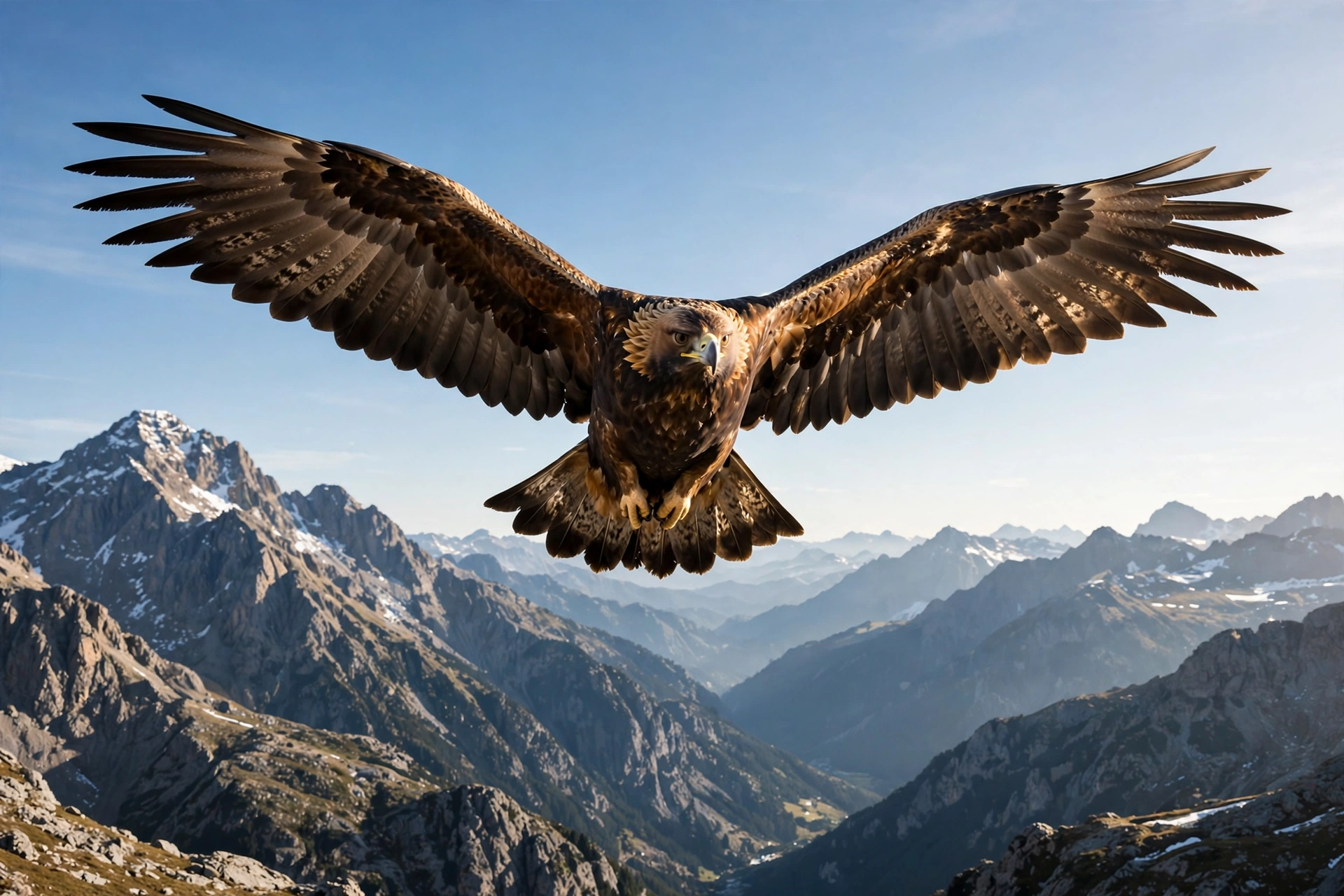
Eagles have fascinated people for thousands of years. They appear on flags, coins and emblems, star in stories and legends, and command the sky as some of the most powerful birds of prey on Earth. But beyond the symbolism, eagles are remarkable animals in their own right. Here are the facts that make them so impressive.
How many eagle species are there?
There are more than 60 species of eagles in the world. Most live in Africa and Eurasia, with a smaller number in North and South America and Australia. They are found on every continent except Antarctica. Eagles belong to the family Accipitridae, which they share with hawks, kites and harriers.
Famous species to know
- Bald eagle — the national bird of the United States, a fish eagle that lives near rivers, lakes and coasts.
- Golden eagle — one of the most widespread eagles in the world, found across North America, Europe and Asia.
- Harpy eagle — one of the largest and most powerful eagles, living in the rainforests of Central and South America.
- Steller’s sea eagle — often described as the largest eagle species, found in far eastern Russia and nearby regions.
- African fish eagle — a striking black, white and chestnut bird that is the national bird of several African countries.
Size and wingspan
Eagles are large birds. Most species measure roughly 60 to 90 centimetres in body length, with wingspans commonly reaching around 1.8 metres or more. The largest species can be considerably bigger — the harpy eagle, for example, has been recorded with a wingspan of over 2 metres. Despite their size, eagles are surprisingly light for their bulk, with hollow bones that keep them agile in the air.
Eyesight that puts ours to shame
An eagle’s eyesight is one of its greatest weapons. Eagles can see several times more sharply than humans, spotting small prey from great distances while soaring high above the ground. Their eyes contain a high density of light-detecting cells and a specialised area of sharp vision, which lets them pick out a fish near the water’s surface or a small mammal moving through grass from far away.
Built for hunting
Eagles are apex predators, sitting at the top of their food chains. They hunt with powerful talons and hooked beaks, and their grip is famously strong — an eagle’s talons can exert many times the gripping force of a human hand. Bald eagles mainly eat fish, snatching them from the water’s surface, while golden eagles take rabbits, ground squirrels and other mammals. Many eagles are also opportunistic: they will scavenge carrion and are known to steal catches from other birds.
Eagles are also fast. In level flight they cruise at moderate speeds, but in a hunting dive they can reach speeds well over 100 kilometres per hour, folding their wings to drop onto prey with precision.
Eagles do not start out looking like adults
Young bald eagles do not have the white head that makes adults so recognisable. Juveniles are mostly dark brown, and the classic white head and tail develop gradually over several years, usually appearing fully by around four to five years of age. The beak also changes colour with maturity, turning yellow as the bird reaches adulthood.
Family life and nests
Eagles are generally monogamous and often pair for life, returning to the same nesting territory year after year. Their nests — built from sticks in tall trees or on cliffs — can become enormous over years of repair and reuse, sometimes reaching several metres across. A typical clutch is one to three eggs, and both parents share incubation and feeding duties.
Eagles in culture
Few birds carry as much symbolism as the eagle. Eagles represent strength, freedom, vision and courage in cultures around the world. They appear on national emblems, military insignia and sports logos, and in many Indigenous cultures eagle feathers carry deep ceremonial significance. The bald eagle’s recovery in the United States — from endangered status to a widespread, thriving population — is also one of conservation’s best-known success stories.
Conservation: not all eagles are safe
While some species like the bald eagle have recovered strongly, others remain in trouble. Habitat loss, persecution, poisoning and collisions with power lines threaten several species. A number of eagle species are listed as vulnerable or endangered, and those with small ranges or specialised diets are the most at risk. Protecting nesting habitats and reducing threats like lead poisoning in prey remains important work.
Quick facts table
- Species worldwide: more than 60
- Found on: every continent except Antarctica
- Typical wingspan: around 1.8 metres for many species, larger for the biggest eagles
- Lifespan: commonly 20 to 30 years in the wild for well-known species
- Diet: fish, mammals, birds, reptiles and carrion, depending on species
- Young per clutch: usually one to three eggs
- Most famous species: bald eagle and golden eagle
FAQs
Q: What is the largest eagle in the world?
A: The Steller’s sea eagle is often described as the largest by size and weight, while the harpy eagle rivals it in power and has the largest talons of any eagle.
Q: How far can an eagle see?
A: Eagles can spot prey from a great distance — several times farther than a human with normal vision could. Their sharp eyesight is one of the key adaptations that makes them such effective hunters.
Q: Do eagles mate for life?
A: Eagles generally pair for life and return to the same nesting area each year, though a bird may find a new mate if its partner dies.
Q: Are eagles endangered?
A: It depends on the species. Bald eagles have recovered well, but several other eagle species are vulnerable or endangered, mainly because of habitat loss and human-related threats.
The bottom line
Eagles combine size, speed, eyesight and intelligence in a way few other animals match. Whether it is a bald eagle fishing along a river or a golden eagle soaring over mountain ridges, these birds earn their reputation as the kings of the sky — and they are worth protecting for generations to come.
Sources: SeaWorld: Eagle Facts; Iowa DNR: Cool Things You Should Know About Bald Eagles.