
Direct answer
You can keep rotisserie chicken in the fridge for 3 to 4 days, as long as it was refrigerated promptly and kept at or below 40°F (4°C). That is the United States Department of Agriculture (USDA) guidance for cooked poultry, and it applies whether the chicken came from a supermarket, a restaurant, or your own oven.
Count day one as the day the chicken was cooked or bought, not the day you first open the container. If you bought it on Monday and put it straight in the fridge, Monday is day one, and Thursday is the last safe day. If you cannot remember which day it went in, throw it out. A label with the date on the container removes that guesswork completely.
When the storage clock starts
The clock starts at cooking or purchase, and the first two hours matter most. Rotisserie chicken should go into the fridge within 2 hours of cooking or buying it. If the room, car, or kitchen is above 90°F (32°C), that window drops to 1 hour.
This is because bacteria grow fastest between 40°F and 140°F, the range food-safety agencies call the danger zone. Refrigeration slows that growth but does not stop it, which is why a chicken that sat out all afternoon is not made safe by putting it in the fridge later. If it was left out for more than 2 hours, discard it, even if it still smells normal.
Store-bought chicken has one extra trap: the time it spends in a hot car on the way home counts. On a warm day, take it home promptly, and if you have other errands, buy the chicken last.
How to store rotisserie chicken properly
Good storage is what gets you the full 3 to 4 days instead of a shorter, lower-quality window:
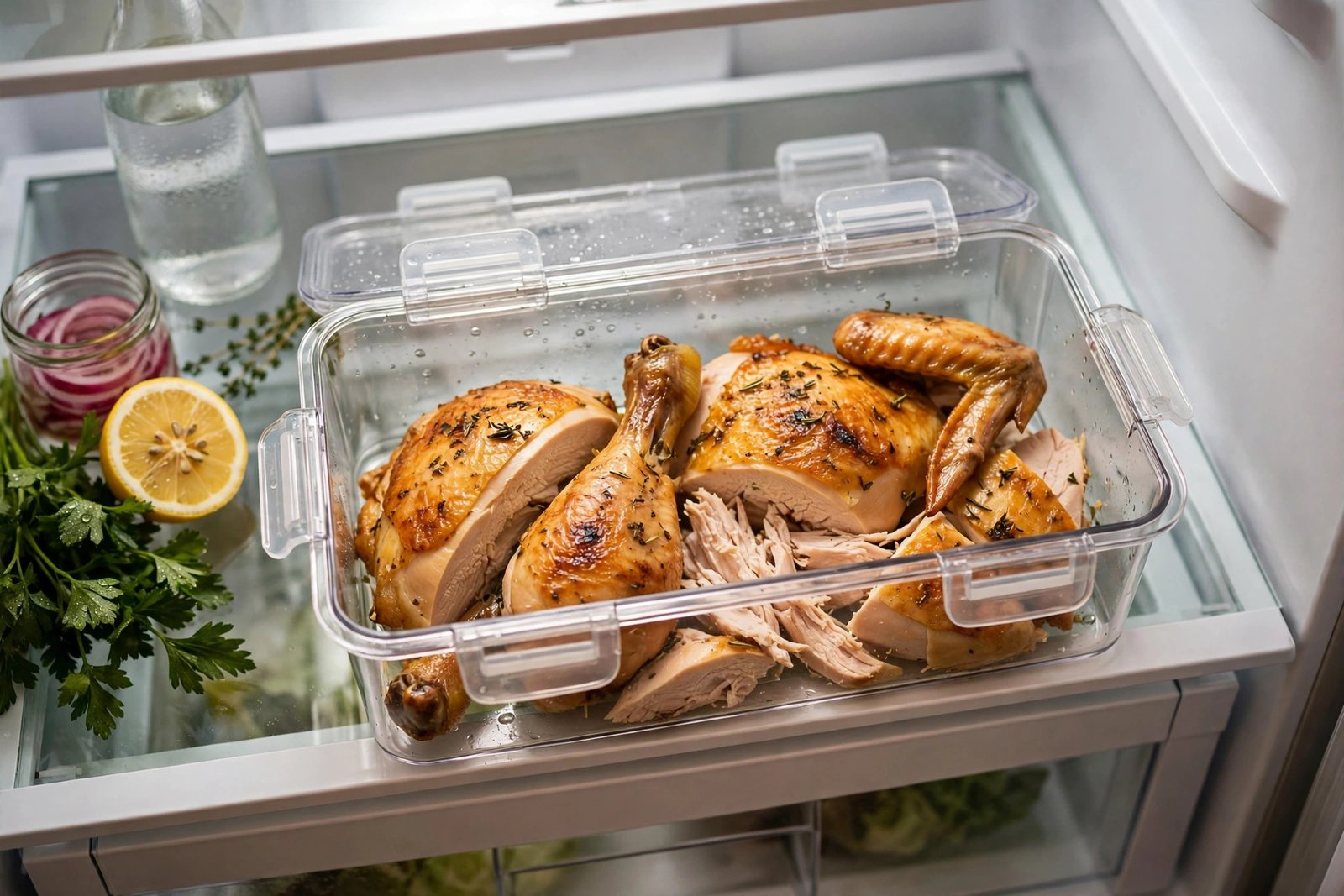
- Carve it first, if you can. Pull the meat off the bone and divide it into meal-sized portions. Smaller portions cool faster and are easier to use up without reheating the whole bird again.
- Use a shallow, airtight container. Shallow containers cool food faster than one deep container, and a tight lid stops the chicken drying out and picking up fridge odours.
- Do not rely on the store packaging alone. The plastic dome or bag it came in is fine for the trip home, but for storage, transfer the chicken to a sealed container or a resealable bag with the air pressed out.
- Keep it on an inside shelf, not in the door. The door is the warmest, least steady part of the fridge, because its temperature swings every time it opens.
- Label it with the date. Write the cooking or purchase date on the container, and use the older batch first if there are two.
The same fridge rules apply to other cooked leftovers. For example, how long cooked eggs last in the fridge follows a similar 3 to 4 day pattern, and how long pizza is good in the fridge uses the same 2-hour rule for food left out at room temperature. More storage guides are in the Cooking & Kitchen section.
Whole chicken vs pieces: does it matter?
A whole rotisserie chicken holds up slightly better in quality than chopped or shredded meat, because less surface area is exposed to air. That does not change the safety window, though. Whole birds and pieces are both safe for the same 3 to 4 days in the fridge, so use that as your rule either way.
What does change is how the chicken eats on day three or four. Sliced breast meat dries out faster than thigh meat, and skin that was crisp on day one will be soft after refrigeration. That is a quality issue, not a safety one, and it is easily fixed by using older chicken in a hot dish rather than eating it cold.
A simple day-by-day plan
| Day | Best use |
|---|---|
| Day 1–2 | Best for cold uses: sandwiches, wraps, salads, and sliced chicken straight from the fridge |
| Day 3–4 | Best for hot dishes: soups, stir-fries, pasta, and casseroles, reheated to 165°F throughout |
| After day 4 | Do not eat it. Freeze any extra before day 4 instead, or discard it |
This plan also answers the most common follow-up question: can you eat rotisserie chicken after 5 days? No. After 4 days, the risk of bacterial growth is too high, even if the chicken looks and smells fine. Smell is not a reliable safety test, because harmful bacteria can be present without any obvious odour or visible change.
Can you eat rotisserie chicken cold?
Yes. Properly cooked and refrigerated rotisserie chicken can be eaten cold within the 3 to 4 day window, for example in sandwiches, wraps, and salads. Ready-prepared chicken that has been handled and stored safely does not have to be reheated to be safe.
The same time limits still apply to cold dishes once they are prepared. Do not leave a prepared chicken sandwich or salad out for a long period: the 2-hour rule still applies, or 1 hour when temperatures are above 90°F.
Freezing rotisserie chicken
If you will not finish the chicken within 4 days, freeze it while it is still fresh, ideally on day one or two. Frozen food kept continuously at 0°F or below stays safe indefinitely, but its quality drops over time. For rotisserie chicken, up to 4 months is the usual best-quality window.
To freeze it well:
- Remove the meat from the bones and divide it into meal-sized portions.
- Wrap each portion tightly in plastic wrap or foil, then place it in a freezer bag or airtight container with as much air pressed out as possible.
- Label the bag with the contents and the freezing date.
- Thaw it in the fridge overnight, never on the counter, and reheat it to 165°F.
Refreezing: chicken that was thawed safely in the fridge and kept properly chilled can be refrozen without reheating, although its texture and flavour may decline. Once thawed chicken is cooked into a new dish, that dish can be refrigerated again for 3 to 4 days like any other cooked leftover. This corrects the stricter wording in the first version of this article.
How to tell if rotisserie chicken has gone bad
Throw it out if you notice any of these, and do not taste-test your way past them:
- A sour, rancid, or unusually sharp smell
- A slimy or sticky texture on the meat
- Grey, green, or pink discoloration, or any mould
- A container that was left out for more than 2 hours, or a fridge that was off for more than 4 hours during a power cut
When in doubt, throw it out. The risk is higher for children, pregnant women, older adults, and anyone with a weakened immune system, and a few portions of chicken are never worth a case of food poisoning.
What if the power goes out?
A closed refrigerator generally keeps food cold for about four hours during a power outage. FoodSafety.gov recommends discarding refrigerated perishable foods, including cooked chicken, after four hours without power. Chicken exposed to temperatures above 40°F for more than two hours should also be discarded. Do not open the fridge door repeatedly to check, because that lets the cold air out faster.
How to reheat rotisserie chicken safely
Reheat only the portion you plan to eat, and heat it until it reaches 165°F (74°C) throughout, measured with a food thermometer. Stir soups and sauces while reheating so the heat spreads evenly, and do not reheat the same portion more than once. Reheating does not make chicken safe if it was already stored improperly or kept beyond the recommended period.
Reheating in the oven
Place the chicken in an oven-safe dish and add a small amount of water or chicken broth. Cover the dish with foil to help retain moisture, then heat until the thickest part of the chicken reaches 165°F. This method works particularly well for larger portions.
Reheating in the microwave
Arrange small pieces of chicken in a microwave-safe container. Add a little moisture, cover with a microwave-safe lid or covering, and heat in short intervals. Rotate or stir the pieces for even heating, and check the internal temperature before serving.
Reheating on the stovetop
Place shredded chicken in a covered skillet with a small amount of broth or water. Heat gently, stirring occasionally, until the chicken reaches 165°F throughout.
For the best texture, the skin will not crisp up again the way it was on day one, but the meat will stay moist if it is covered and not overheated.
FAQs
Q: Can I eat rotisserie chicken after 5 days in the fridge?
A: No. The safe window is 3 to 4 days. After that, discard it, even if it looks and smells normal.
Q: Does the clock start when I buy it or when I open it?
A: When it was cooked or bought, whichever is earlier. Opening the container does not restart the clock.
Q: Can I leave rotisserie chicken out for dinner and put the rest back?
A: Only if the total time out of the fridge stays under 2 hours (1 hour above 90°F). Food left out longer than that should be discarded, not refrigerated again.
Q: How long does frozen rotisserie chicken last?
A: It stays safe indefinitely at 0°F, but for best quality, use it within about 4 months.
Q: Can I freeze rotisserie chicken in its store container?
A: It is better not to. Transfer it to airtight freezer packaging with the air pressed out to prevent freezer burn and drying. You can transport it home in the original packaging, but shallow, covered containers are generally better for cooling and storing leftovers.
Q: Does Costco rotisserie chicken last longer in the fridge?
A: No. Costco rotisserie chicken follows the same USDA recommendation as other store-bought fully cooked chicken: 3 to 4 days when properly refrigerated at 40°F or below.
Q: Can I refreeze rotisserie chicken after thawing?
A: Yes, if it was thawed safely in the refrigerator and remained properly chilled. USDA guidance allows previously cooked leftovers to be refrozen without reheating, although their quality may decline.
Q: Does reheating rotisserie chicken extend its fridge life?
A: No. Reheating does not rescue chicken that has exceeded its safe storage period. Store leftovers promptly, follow the recommended storage window, and reheat to 165°F when serving them hot.
Q: What if my refrigerator loses power while storing chicken?
A: A closed refrigerator generally keeps food cold for about four hours during a power outage. Discard refrigerated perishable foods, including cooked chicken, after four hours without power, and discard chicken exposed to temperatures above 40°F for more than two hours.
Sources
- USDA FSIS — Chicken From Farm to Table: https://www.fsis.usda.gov/food-safety/safe-food-handling-and-preparation/poultry/chicken-farm-table
- USDA — Suggested Refrigerator Storage Times for Chicken: https://ask.fsis.usda.gov/article/What-are-suggested-refrigerator-storage-times-for-chicken
- USDA FSIS — Freezing and Food Safety: https://www.fsis.usda.gov/food-safety/safe-food-handling-and-preparation/food-safety-basics/freezing-and-food-safety
- FoodSafety.gov — Cold Food Storage Chart: https://www.foodsafety.gov/food-safety-charts/cold-food-storage-charts
- FoodSafety.gov — Food Safety During Power Outages: https://www.foodsafety.gov/food-safety-charts/food-safety-during-power-outage
- Southern Living, How Long Does Cooked Chicken Last in the Fridge: https://www.southernliving.com/how-long-cooked-chicken-last-fridge-11953656
- Fridge.com, How Long Does Rotisserie Chicken Last in the Fridge: https://fridge.com/blogs/news/how-long-does-rotisserie-chicken-last-in-the-fridge