
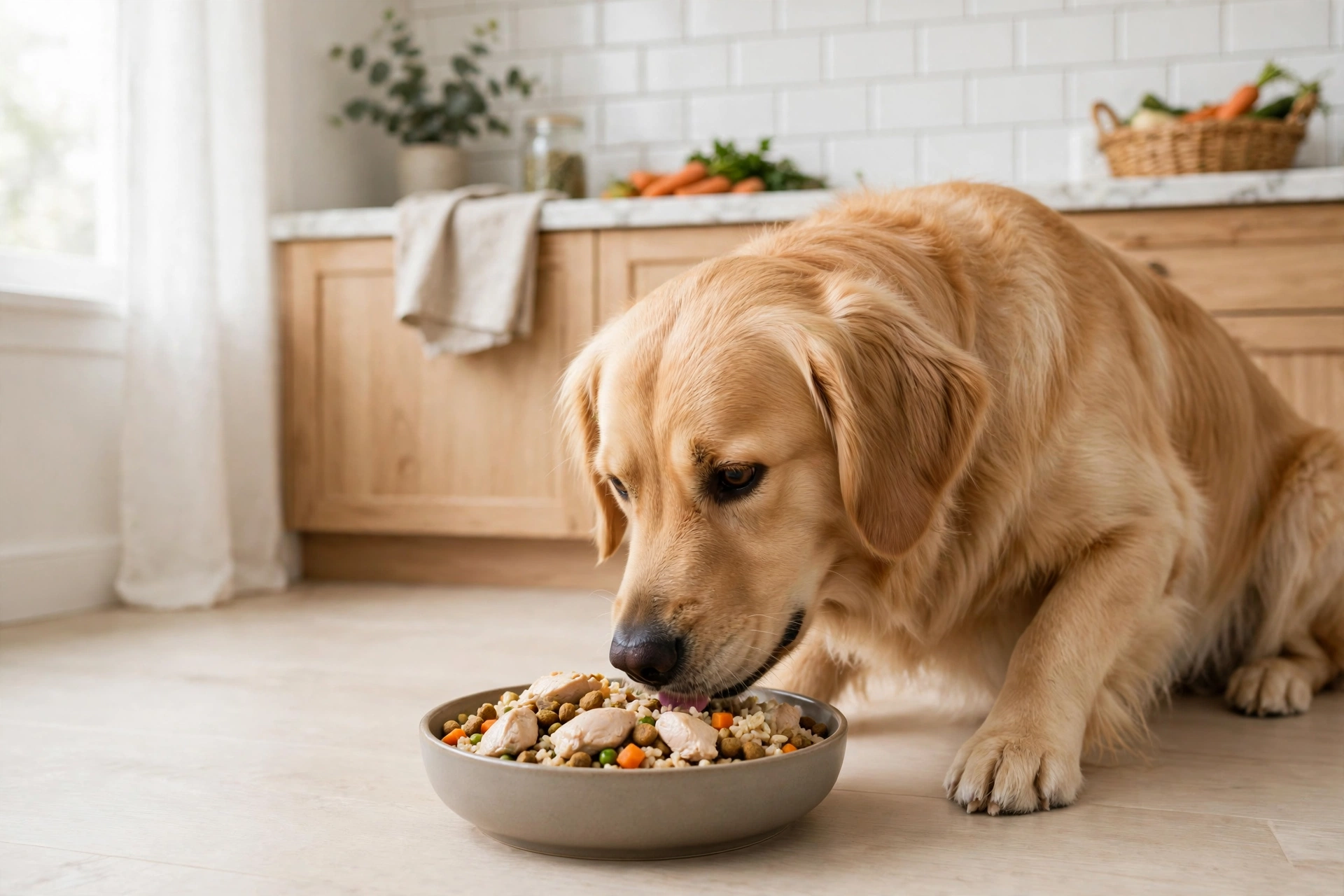
What is the best dog food for a sensitive stomach? Ask five people and you will get five brands. The more useful question is different: what makes a food easier on a sensitive stomach, and how do you tell whether it is working for your dog? Brands matter less than the framework — a digestible protein, the right kind of fibre, a short ingredient list, and a slow transition — plus knowing when a sensitive stomach is actually a vet visit in disguise.
This article gives general information only. It is not veterinary advice. Persistent vomiting or diarrhoea, blood in stools, weight loss, or a change in appetite should be assessed by a veterinarian before any diet change.
What “sensitive stomach” usually means
A sensitive stomach is a description, not a diagnosis. It usually means a dog that regularly has loose stools, gas, occasional vomiting, or gurgling after eating, without an identified disease. Causes vary: a food intolerance, eating too fast, a sudden diet change, table scraps, stress, parasites, or an underlying condition such as pancreatitis or inflammatory bowel disease. That variety is exactly why a food that transformed one dog can do nothing for another — the underlying cause was different.
Before changing food, rule out the simple things. A dog that raids bins, eats garden debris, or gets many different treats is not testing a diet at all; it is testing everything at once. Worming also matters: our guide to the best time to deworm a dog covers a routine that is easy to overlook when blaming food. And keep the environment consistent — a new food trialled alongside a house move or a new pet is uninterpretable.
The selection framework: protein, fibre, and simplicity
Protein comes first. Sensitive-stomach foods usually use a single, easily digestible protein — salmon, lamb, turkey, or duck — rather than several mixed proteins. This is partly about digestibility and partly about diagnosis: with one protein, you can tell whether that protein suits your dog. Chicken is the classic bland-diet protein, but it is also one of the more common food allergens in dogs, so a dog that does not improve on chicken and rice may improve on a novel protein such as fish or venison. If a food lists a long chain of protein meals and by-products, it is not a limited-ingredient food, whatever the bag claims.
Fibre type matters as much as fibre amount, and this is the detail most product lists skip. Soluble fibre — from pumpkin, beet pulp, or chicory root — dissolves in water, slows digestion, and helps firm loose stools. Insoluble fibre — cellulose, pea fibre, bran — adds bulk and speeds transit, which can make loose stools worse. Most well-regarded sensitive-stomach formulas use beet pulp or pumpkin as the primary fibre source for this reason. A food that is high in fibre but from the wrong sources may not help at all.
Simplicity is the third leg. Shorter ingredient lists make it easier to identify a trigger, and foods free of artificial colours, flavours, and preservatives remove a whole class of possible irritants. Grain-free is not automatically better: some dogs do well on rice or oatmeal, which are gentle, digestible carbohydrates, while others react to a particular grain. Judge by the dog, not by the trend.
The well-known options, in context
The foods that veterinarians and reviewers mention most often share the framework above rather than a secret ingredient. Purina Pro Plan Sensitive Skin & Stomach (often salmon and rice, with prebiotics) and Hill’s Science Diet Sensitive Stomach & Skin are the two most frequently recommended over-the-counter options. Royal Canin Digestive Care and limited-ingredient diets such as Natural Balance LID (for example duck and potato) suit dogs that need a single novel protein. For confirmed food allergies, prescription hydrolysed diets — where the protein is broken down so the immune system does not recognise it — are a veterinary decision, not a shelf choice.
No ranking replaces a trial. A food’s position on a list reflects other dogs’ results, and your dog’s gut has the only vote that counts.
How to switch: slow, and one change at a time
Switching food too fast is the most common reason a sensitive-stomach trial fails. Transition over 7 to 10 days: start with roughly three-quarters old food and one-quarter new, move to half and half, then three-quarters new, then fully new, slowing down if stools loosen. Change nothing else during the trial — no new treats, no new table scraps, no new chews. Give the new food two to three weeks before judging it, unless symptoms worsen, in which case stop and seek veterinary advice.
Judge by more than stool count: stool form, straining, gas, vomiting, appetite, energy, and coat condition all count. Keep a simple log for the trial period; memory is unreliable about a dog’s digestion, and a log is exactly what a vet will ask for if the trial does not work. And remember the practical side of sensitive stomachs: accidents happen, and our guide to removing pet stains naturally helps keep the house liveable while you work through a diet change.
When a vet is needed, not a new bag
See a veterinarian promptly for persistent diarrhoea or vomiting, blood or black stools, weight loss, loss of appetite, lethargy, a swollen or painful abdomen, or symptoms in a puppy, senior dog, or a dog with a known illness. A vet can test for parasites, check for pancreatitis or other disease, and advise whether a prescription or hydrolysed diet is needed. A sensitive stomach that does not improve after two sensible food trials is also a vet visit, not a third bag.
Frequently asked questions
What protein is best for a dog with a sensitive stomach?
A single, digestible protein such as salmon, lamb, or duck. Chicken suits many dogs but is a common allergen, so a novel protein is worth trying if chicken does not help.
How long does it take for a new food to help?
Often two to three weeks of consistent feeding, after a 7 to 10 day transition. Judging after two days is too soon.
Is grain-free better for sensitive stomachs?
Not necessarily. Rice and oatmeal are gentle carbohydrates that suit many sensitive dogs. Judge by the dog’s response, not by the label trend.
Can I feed a sensitive-stomach food long term?
Yes, if it is complete and balanced for your dog’s life stage and the dog does well on it. Do not feed puppy food to a senior, or vice versa, even to ease a stomach.
Should puppies with sensitive stomachs eat adult sensitive food?
No. Puppies need puppy-formulated food for growth; choose a sensitive-stomach formula made for puppies, and ask a vet if symptoms persist.
The best dog food for a sensitive stomach is the one that fits the framework and fits your dog: one digestible protein, the right fibre, a short ingredient list, and a slow, single-change trial judged over weeks. When that trial works, you have your answer; when it does not, a vet — not another bag — is the next step.
Browse more in Pets.
Sources: Vetstreet on sensitive stomach dog foods; Chewy on choosing food for sensitive stomachs.