
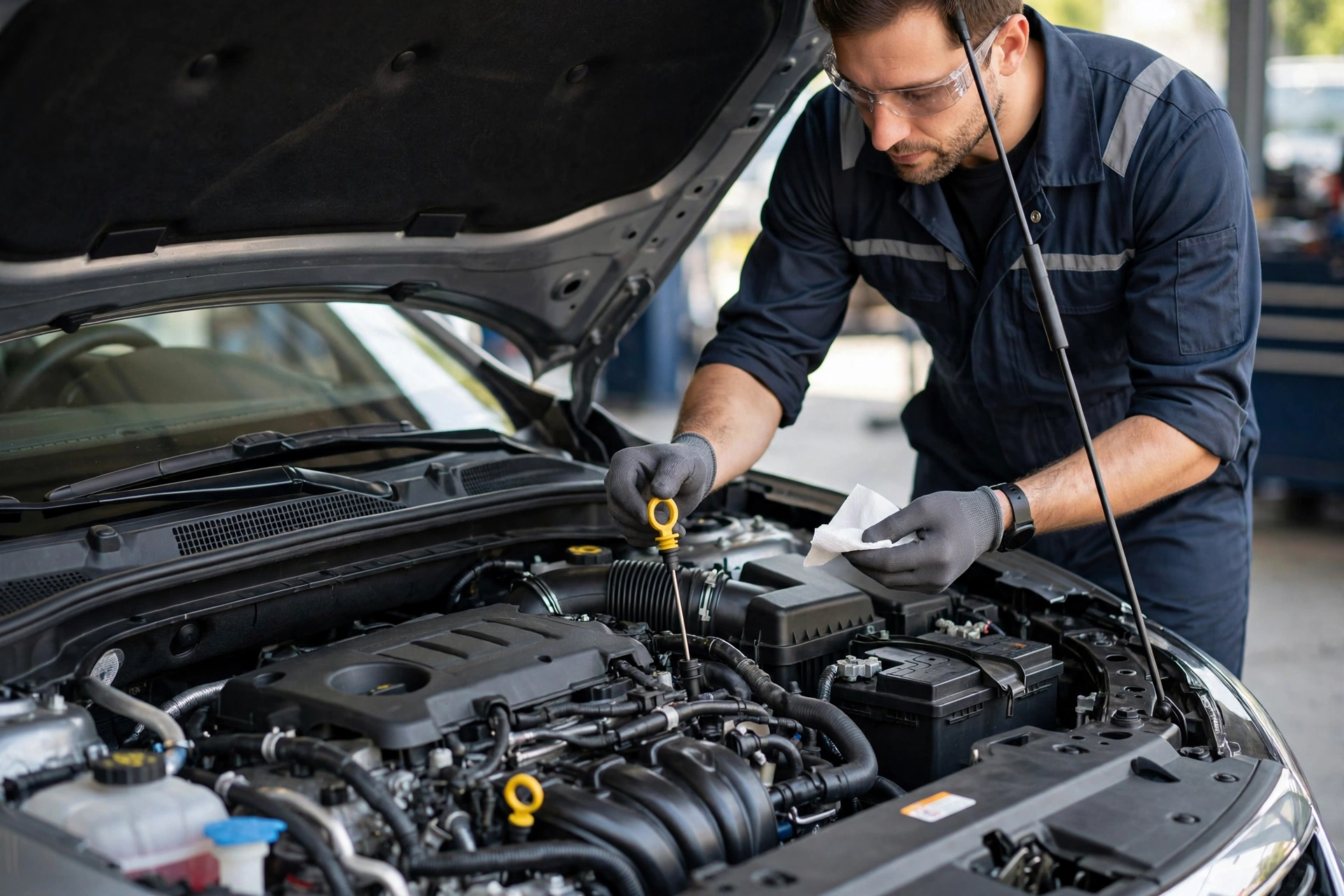
A burning oil smell in a car is one of those warnings that is easy to ignore and unwise to ignore. It usually means engine oil has escaped its sealed circuit and reached something hot enough to vaporise it — most often the exhaust manifold. The smell itself is distinctive: heavy, acrid, slightly sweet, and different from the sickly-sweet smell of burning coolant or the sharp chemical smell of transmission fluid. Learning to read the pattern of the smell — when it appears, where it is strongest, and what else is happening — points to the cause faster than guessing at parts.
Safety first: if the smell is strong, if you see smoke or flames, or if the oil warning light is on, stop in a safe place, switch the engine off, and do not keep driving to “see if it clears.” Oil on a hot exhaust is a fire risk, and a car losing oil can suffer serious engine damage quickly. The checks below are for a mild smell with no warning lights and no visible smoke; anything more dramatic needs a professional, not a driveway inspection.
Step one: read the smell pattern
The pattern narrows the cause before you open the bonnet. A smell that is strongest inside the cabin when stopped at lights, or just after parking, usually means oil is dripping onto a hot part near the ventilation intake, and the fumes are being drawn in when airflow stops. A smell noticed only after a drive, fading as the car cools, fits a small external leak burning off hot metal. A smell present constantly, with blue or grey smoke from the exhaust and rising oil consumption, points instead to internal burning: oil entering the combustion chamber through worn piston rings or valve seals and leaving through the exhaust.
A smell that appeared right after an oil change and fades over a few days is often just spilled oil burning off the engine — annoying but harmless, and worth mentioning to the service centre if it persists. A smell that appears gradually and grows stronger over weeks is more likely an active leak that needs finding.
Step two: the safe checks
With the engine off and cool enough to touch safely, check the oil level on the dipstick. A level that is dropping between checks confirms oil is going somewhere it should not. Look under the car for fresh spots on the ground, and around the engine bay for wet, dark traces — but do not reach into a hot engine bay, and never open a cooling system cap when hot. Trace any wetness upward: oil flows down, so the highest wet point is usually near the source.
Check the simple suspects first. The oil filler cap should be tight and its seal intact. Around the oil filter and drain plug, look for seepage, especially after a service — a double gasket (the old filter’s rubber ring left in place) or a drain plug missing its crush washer can leak surprisingly fast. If you find heavy corrosion or wetness around electrical parts, leave it to a professional; as with a smoke alarm that keeps sounding for no clear reason, a warning that will not go away usually has a cause worth finding properly, which our guide to smoke alarms also illustrates in a home setting.
The common causes, in order of likelihood
Valve cover gasket leaks are the most common cause. This gasket seals the top of the engine, where the valve train splashes oil around. Heat cycling hardens the rubber over time, it loses its seal, and oil runs down the side of the engine onto the exhaust manifold below. The result is a strong smell after short drives and sometimes wisps of smoke from the engine bay when you stop.
Oil pan gasket and drain plug leaks come next. The oil pan is the reservoir at the bottom of the engine; its gasket shrinks with age, and a poorly sealed drain plug after a service does the same job badly. Oil from here usually drips onto the road, but airflow underneath can blow it back onto hot transmission or exhaust parts.
Crankshaft seals, front and rear, are less accessible and more expensive: they seal where the crankshaft exits the engine block, and failure can leak a significant volume. Turbocharged cars add another suspect — oil feed and return lines to the turbo, where a worn seal can spray oil onto an extremely hot housing.
Internal causes are a different category. Worn piston rings or valve seals let oil into the combustion chamber, where it burns and exits as blue-grey exhaust smoke. A faulty PCV (positive crankcase ventilation) system can also raise crankcase pressure, forcing oil past seals, and increasing oil vapour burned through the intake. Low oil level itself can worsen the smell: with too little oil, lubrication fails, friction rises, and the remaining oil overheats and breaks down, producing a harsh burning odour and risking engine seizure.
What to do, and what not to do
If the oil level is only slightly low and there is no smoke, no warning light, and no heavy leak, topping up with the correct grade and booking a prompt inspection is reasonable. Do not use stop-leak additives as a substitute for diagnosis; they can clog narrow oil passages. Do not keep driving with a falling oil level, a lit oil warning, or visible smoke — those are stop-now signs, and towing is cheaper than an engine.
At the garage, expect the mechanic to clean the engine bay, run the engine, and watch for the fresh leak — the standard way to find a source that is otherwise hidden under old grime. Ask what failed, not just what was replaced: a valve cover gasket replaced while a clogged PCV valve remains will leak again.
Frequently asked questions
Is a burning oil smell dangerous?
It can be. Oil on a hot exhaust is a fire risk, and oil loss can damage the engine. A strong smell, smoke, or an oil warning light means stop and get help.
Why does the smell get worse when I stop?
When driving, airflow disperses fumes. When you stop, fumes rise and are drawn into the cabin through the ventilation intake, so the smell becomes noticeable.
Can I drive with a small oil leak?
Only briefly, to a repairer, if the oil level is safe, there is no smoke, and no warning light. Check the level before driving and do not delay the repair.
Does low oil itself cause a burning smell?
Yes, indirectly: too little oil means poor lubrication, more friction, and overheated, degraded oil, which smells harsh and signals damage is possible.
How much does fixing a burning oil smell cost?
It varies widely: a valve cover gasket is usually a modest repair, while crankshaft seals or internal engine wear cost much more. Diagnosis first prevents replacing the wrong part.
A burning oil smell is your car’s way of saying oil is where it should not be. Read the pattern, check the level and the simple suspects safely, and treat a strong smell or a warning light as a stop signal. Most causes are common gasket and seal failures that a mechanic can find quickly — but only if the car gets to them before the leak becomes a breakdown.
Related reading: how to clean a mechanical keyboard.
Browse more in How Things Work.
Sources: EngineerFix on burning oil smell; Motoring Chronicle on burning oil smell.