
Short answer
A crystal is not a single stone. It is a structure: a solid whose atoms are arranged in a regular, repeating pattern in three dimensions. Quartz, by contrast, is one specific mineral. It is made of silicon dioxide, and it has a crystalline structure — which means all quartz is crystalline, but most crystals are not quartz.
That one distinction clears up most of the confusion. When a shop label says “crystal”, it may mean a natural crystal, a cut stone, or even lead glass. When it says “quartz”, it means a particular mineral with a particular chemistry.
What is a crystal?
A crystal forms when atoms, ions, or molecules settle into an orderly, repeating arrangement as a liquid cools, a solution evaporates, or pressure and temperature change underground. The pattern repeats over and over, which is why many crystals grow with flat faces and regular shapes.
Crystals can be natural or made by people. Table salt is a crystal. So is snow, sugar, and diamond. Some crystals are minerals, meaning they are naturally occurring, inorganic solids with a definite composition and structure. Others are not minerals at all: sugar, for example, is crystalline because of its repeating structure, but it comes from a plant and is organic, so it is not counted as a mineral.
The word itself comes from the Greek word “krystallos”, meaning ice. Early observers thought clear quartz was ice frozen so hard that it would never melt. The name stuck, even after the chemistry was understood.
What is quartz?
Quartz is a mineral composed of silicon and oxygen, in the chemical form silicon dioxide. It is one of the most common minerals in the Earth’s crust, found in sand, sandstone, granite, and many other rocks.
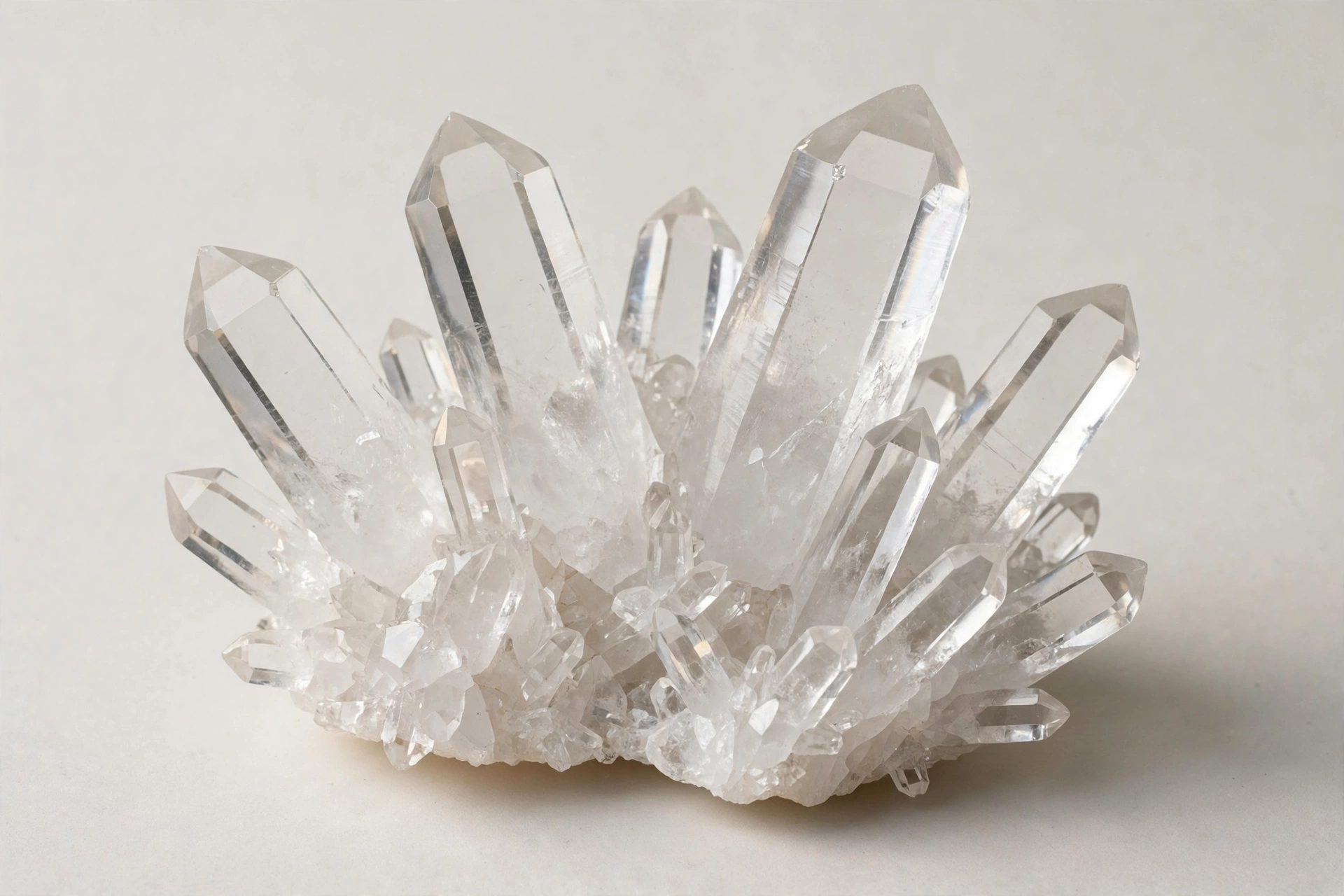
Quartz usually appears as six-sided prisms topped with a pointed end, although it also occurs as grains too small to see individually. Its hardness is 7 on the Mohs scale, which means it can scratch ordinary glass. It breaks with a curved, shell-like fracture rather than splitting along flat planes, and it has a glassy lustre.
Colour in quartz usually comes from tiny impurities or defects in its structure, not from a different base chemistry. That is why the same mineral can look so different from one specimen to another.
Quartz vs crystal at a glance
| Feature | Crystal (general term) | Quartz (specific mineral) |
|---|---|---|
| What it is | A structure with a repeating atomic pattern | A mineral made of silicon dioxide |
| Composition | Varies — many different chemistries | Fixed base chemistry, with trace impurities |
| Examples | Diamond, salt, sugar, quartz, calcite | Amethyst, rose quartz, citrine, rock crystal |
| Hardness | Varies widely by material | 7 on the Mohs scale |
| Found in | Nature and laboratories | Rocks, sand, veins, and geodes worldwide |
Common types of quartz
Rock crystal is the clear, colourless variety of quartz, with no colour-causing impurities. Amethyst is purple quartz, coloured by iron and natural radiation. Rose quartz gets its soft pink colour from trace elements, while citrine ranges from pale yellow to brownish orange. Smoky quartz is grey to brown, and milky quartz looks cloudy because of tiny fluid inclusions.
These are all quartz. Their differences in colour and clarity do not change their basic identity, although they do affect how they are used in jewellery and decoration.
How to tell quartz from other crystals
If you are trying to identify a stone at home, look for a combination of clues rather than relying on colour alone:
- Lustre and clarity. Quartz usually has a glassy shine and ranges from transparent to translucent.
- Hardness. Quartz scratches glass and steel, but it is scratched by harder materials such as topaz and corundum.
- Fracture. Instead of breaking along flat, clean planes, quartz tends to break into curved, shell-like pieces.
- Shape. Well-formed quartz crystals often show six-sided prisms.
- Streak. Rubbed on an unglazed tile, quartz leaves a white or colourless streak.
Calcite, which is sometimes mistaken for quartz, is softer, reacts with dilute acid, and splits along flat planes. Glass, by contrast, has no crystal structure at all, even when it is cut to look like a gemstone. That is an important difference: “crystal glass” in shops is usually lead glass, valued for its sparkle and weight, not a natural crystal.
Where quartz is used
Quartz is far more than a decorative stone. Because it is hard, chemically stable, and has useful electrical properties, it appears in watches and electronic oscillators, where its steady vibration helps keep time. It is used in optical instruments and in making glass and silicon-based materials. Sand, which is largely quartz, is a basic ingredient in concrete, glass, and ceramics.
Other crystals have their own roles. Diamond is used for cutting and drilling because of its extreme hardness. Salt is essential in food and industry. Calcite is used in cement and as an optical material. The right crystal for a job depends on its chemistry and structure, not simply on whether it looks attractive.
Common misconceptions
“All crystals are quartz.” No. Quartz is one member of a very large family. Diamond, ruby, salt, and ice are all crystalline, but none of them is quartz.
“Quartz and crystal are interchangeable names.” In everyday speech they are often mixed up, especially in jewellery shops, but in mineralogy they are not the same kind of term. One names a structure, the other names a mineral.
“Crystal glass is a natural crystal.” No. It is manufactured glass, shaped and cut to imitate the sparkle of a crystal. It does not have the repeating atomic structure that defines a true crystal.
“Every crystal has special powers.” Claims about healing or energy are beliefs held in some alternative traditions. They are not established by the scientific evidence for the mineral’s physical properties, and this article makes no such claim.
Which word should you use?
Use “quartz” when you mean the specific mineral, whether you are buying jewellery, identifying a rock, or describing sand and granite. Use “crystal” when you are talking about the structure, or when you are describing a material whose exact mineral name you do not yet know. If a seller cannot tell you which mineral a “crystal” actually is, that is worth asking about before you buy.
FAQs
Is quartz a crystal?
Yes. Quartz has a crystalline structure, so it is a crystal in the structural sense. It is also a specific mineral, which is the more precise description.
Are all crystals minerals?
No. A crystal is defined by its structure. A mineral must also be naturally occurring, inorganic, and have a definite composition. Sugar is crystalline but not a mineral.
What is rock crystal?
Rock crystal is the clear, colourless variety of quartz. It is sometimes called mountain crystal. It has the same chemistry as other quartz, without the impurities that create colour.
Is quartz rare?
Quartz itself is very common. Particular varieties, colours, or unusually clear and well-formed specimens can be rarer and more valuable, but the mineral as a whole is abundant.
Can quartz be made synthetically?
Yes. Synthetic quartz is grown under controlled conditions for electronics and optics, where consistent purity matters. Natural quartz may contain impurities that change its colour or clarity.
Conclusion
Think of “crystal” as the blueprint and “quartz” as one house built from it. The blueprint — a repeating, orderly structure — appears in countless materials. Quartz is one well-known example, defined by silicon dioxide, a hardness of 7, a glassy lustre, and a curved fracture. Once you keep the structure and the mineral apart, labels, jewellery descriptions, and rock identifications all become much easier to read.
Related reading on this site
- How Is Ink Made? From Ancient Soot to Modern Printer Ink
- Facts About Eagles: Size, Eyesight, Hunting and Species
- How Things Work
- Health Benefits and Preparation Tips for Nature Walks