
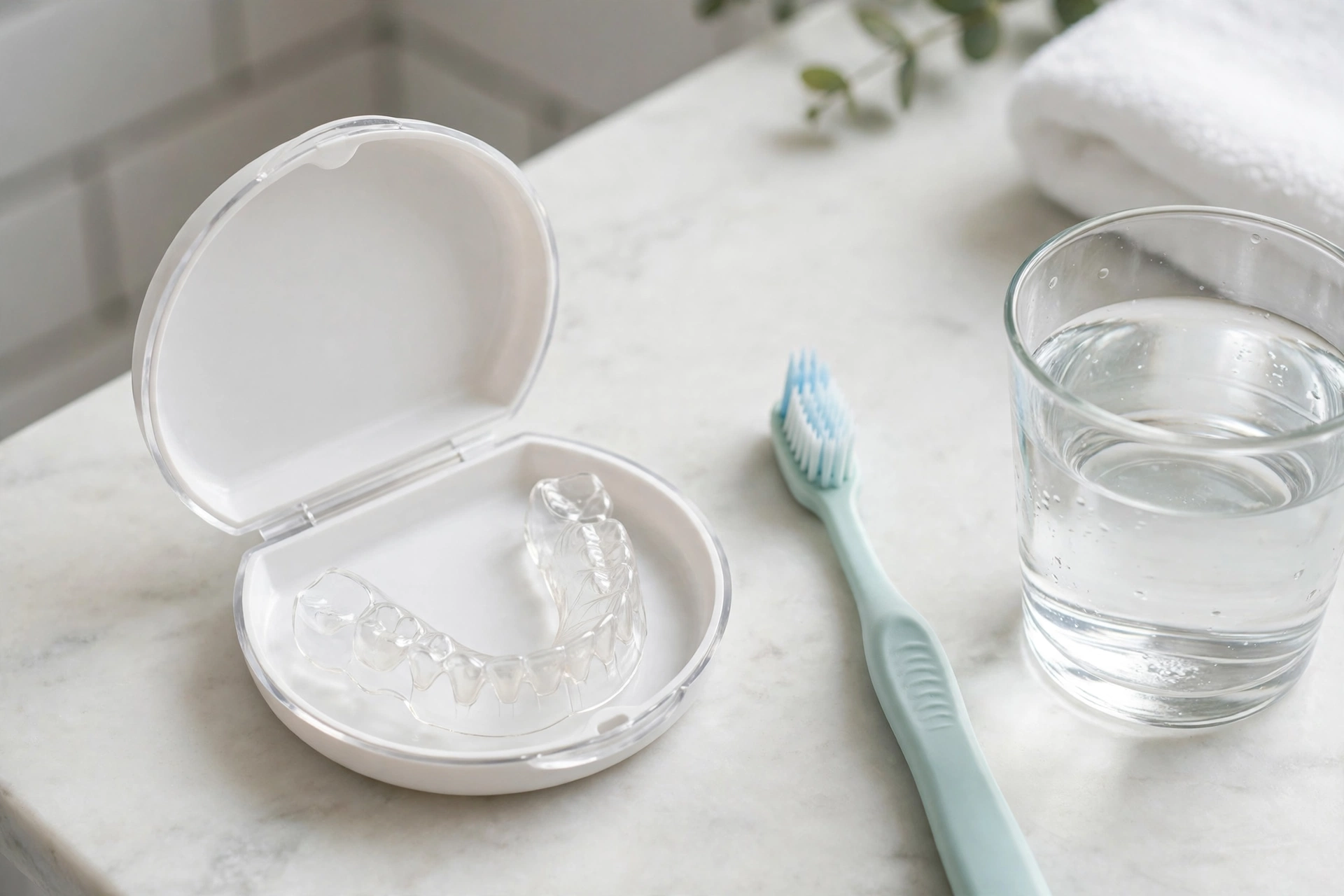
A retainer sits against your teeth and gums for hours every day, so it collects plaque, saliva and bacteria just as teeth do. Left uncleaned, it can start to smell, turn cloudy, and irritate your mouth. The good news is that cleaning a retainer takes only a few minutes a day, and a short weekly routine keeps it clear and fresh.
The direct answer is this: rinse and brush your retainer gently every day with cool water and a mild soap or a cleaner your dentist recommends, deep-clean it once a week with a retainer or denture cleaning tablet, and never use hot water, toothpaste, bleach or alcohol-based cleaners on it. The exact routine depends on which type of retainer you have, so start by identifying yours.
Know your retainer type
There are three common types. A Hawley retainer is the classic wire-and-plastic type, with a metal wire across the front of your teeth and a plastic plate behind them. A clear plastic retainer, often called an Essix retainer, is a thin transparent tray that fits snugly over all your teeth. A fixed or bonded retainer is a thin wire glued to the back of your front teeth; you cannot remove it, so it needs a different cleaning method entirely.
If you are unsure which type you have, your dentist or orthodontist can confirm it in seconds. Do not guess, because a method that is safe for a clear tray can damage a Hawley retainer’s metal parts, and a fixed retainer cannot be soaked at all.
Daily cleaning for removable retainers
Clean your retainer as soon as you take it out, while it is still wet. Once saliva and plaque dry on the surface, they are much harder to remove.
- Rinse it under cool or lukewarm water to wash away loose debris.
- Brush it gently all over with a soft toothbrush kept just for this job. Use a drop of mild, clear liquid soap or a cleaner your dentist has recommended.
- Pay attention to grooves and edges, where plaque collects. A cotton swab can reach into tight corners on a clear tray.
- Rinse thoroughly so no soap taste remains, then either put it back in a clean mouth or store it in its case.
Brush your teeth before putting the retainer back in. Putting a clean retainer over unbrushed teeth traps food and plaque against your enamel, which defeats the purpose of cleaning it. This matters for the same reason as general oral hygiene: a clean mouth and a clean appliance work together, and our guide to what causes bad breath explains how trapped bacteria contribute to odour in the mouth.
Do not use toothpaste on a retainer. Toothpaste is mildly abrasive, and on clear plastic it creates tiny scratches that make the surface cloudy and give bacteria more places to cling. Mild soap, or a paste made from baking soda and water for occasional use, is a safer choice.
Weekly deep cleaning
Once a week, give a removable retainer a deeper clean. The simplest method is a retainer or denture cleaning tablet dissolved in a cup of lukewarm water, following the packet instructions for soaking time — usually around 15 to 20 minutes. Rinse well afterwards.
A baking soda soak is another option: dissolve a spoonful of baking soda in a cup of lukewarm water and soak for a similar time. Be careful with a Hawley retainer, though. Baking soda solutions can corrode metal parts if used too often or for too long, so keep soaks short and occasional for wire retainers, and ask your dentist if you are unsure.
A short rinse with a non-alcoholic mouthwash after soaking can add freshness, but it is optional. Never soak a retainer overnight in a strong solution unless the product label or your dentist specifically says it is safe to do so.
Cleaning a fixed retainer
A fixed retainer cannot be removed, so you clean it the same way you clean your teeth — by brushing and flossing — with a little extra care around the wire.
Brush all around the wire from different angles, using gentle pressure so you do not loosen it. Then floss under the wire using a floss threader: thread a piece of floss under the wire between two teeth, move it up and down gently to the gum line, then slide it sideways to the next gap. It feels awkward at first, but it becomes quick with practice.
Because a fixed retainer cannot be deep-cleaned at home, regular dental check-ups matter even more. Your dentist can remove tartar that builds up around the wire and check that the wire is still firmly bonded.
What to avoid
Heat is the biggest danger. Hot water, boiling water, dishwashers and leaving a retainer in a hot car can warp clear plastic permanently, and a warped retainer no longer fits properly. Always use cool or lukewarm water.
Bleach is too harsh and can damage both plastic and metal, and it can also irritate your mouth. Alcohol-based cleaners can dry out and weaken plastic over time. Strong coloured mouthwashes can stain a clear retainer. And never wrap a retainer in a tissue or napkin when you take it out — that is how most retainers end up accidentally thrown away. Use its case, every time.
Troubleshooting common problems
| Problem | Likely cause | What to do |
|---|---|---|
| Bad smell | Plaque and bacteria from infrequent cleaning | Return to daily brushing and a weekly tablet soak; check you are brushing your teeth before reinserting it |
| Cloudy appearance | Scratches from toothpaste or abrasive cleaning | Switch to mild soap and a soft brush; cloudiness from scratching usually cannot be reversed, so prevention matters |
| White crusty buildup | Hardened plaque or mineral deposits | Soak in a retainer cleaning solution as directed, then brush gently; ask your dentist if it will not come off |
| Cracks or a loose fit | Heat damage or wear | Stop wearing it and contact your dentist — a damaged retainer can move teeth the wrong way |
If a retainer cracks, warps, or no longer fits snugly, do not try to bend it back into shape yourself. Wear it only if your dentist advises it, and get it checked promptly. Teeth can shift surprisingly quickly without a properly fitting retainer.
Storage and daily habits
When your retainer is not in your mouth, keep it in its case. Rinse the case regularly with soap and water too, since a dirty case reintroduces bacteria to a clean retainer. Do not eat or drink while wearing a removable retainer — food and coloured drinks collect under it and stain both the retainer and your teeth. Plain water is the only safe exception.
A good routine is simple: rinse and brush every day, soak once a week, store it in its case, and see your dentist if anything looks or feels wrong. If you are also working on keeping your smile bright, our guide on how to remove coffee stains from teeth covers the tooth side of the same routine. Done consistently, retainer cleaning becomes a two-minute habit, and your retainer stays clear, fresh, and doing the job it was made for.
Frequently asked questions
How often should I clean my retainer?
Every day, with a gentle brush and rinse, plus a deeper soak once a week. Cleaning it daily prevents plaque from hardening and keeps odour away.
Can I use toothpaste to clean my retainer?
No. Toothpaste can scratch clear plastic, making it cloudy and easier for bacteria to cling to. Use mild soap or a retainer cleaner instead.
Can I boil my retainer to sterilise it?
No. Heat warps clear plastic and can ruin the fit. Use cool or lukewarm water only.
What if my retainer smells even after cleaning?
Return to daily cleaning and a weekly soak, clean the case as well, and brush your teeth before reinserting it. If the smell persists, ask your dentist — the retainer may need professional cleaning or replacement.
How do I clean a fixed retainer?
Brush around the wire carefully and floss under it with a floss threader. You cannot soak a fixed retainer, so regular dental check-ups are important for tartar removal.