
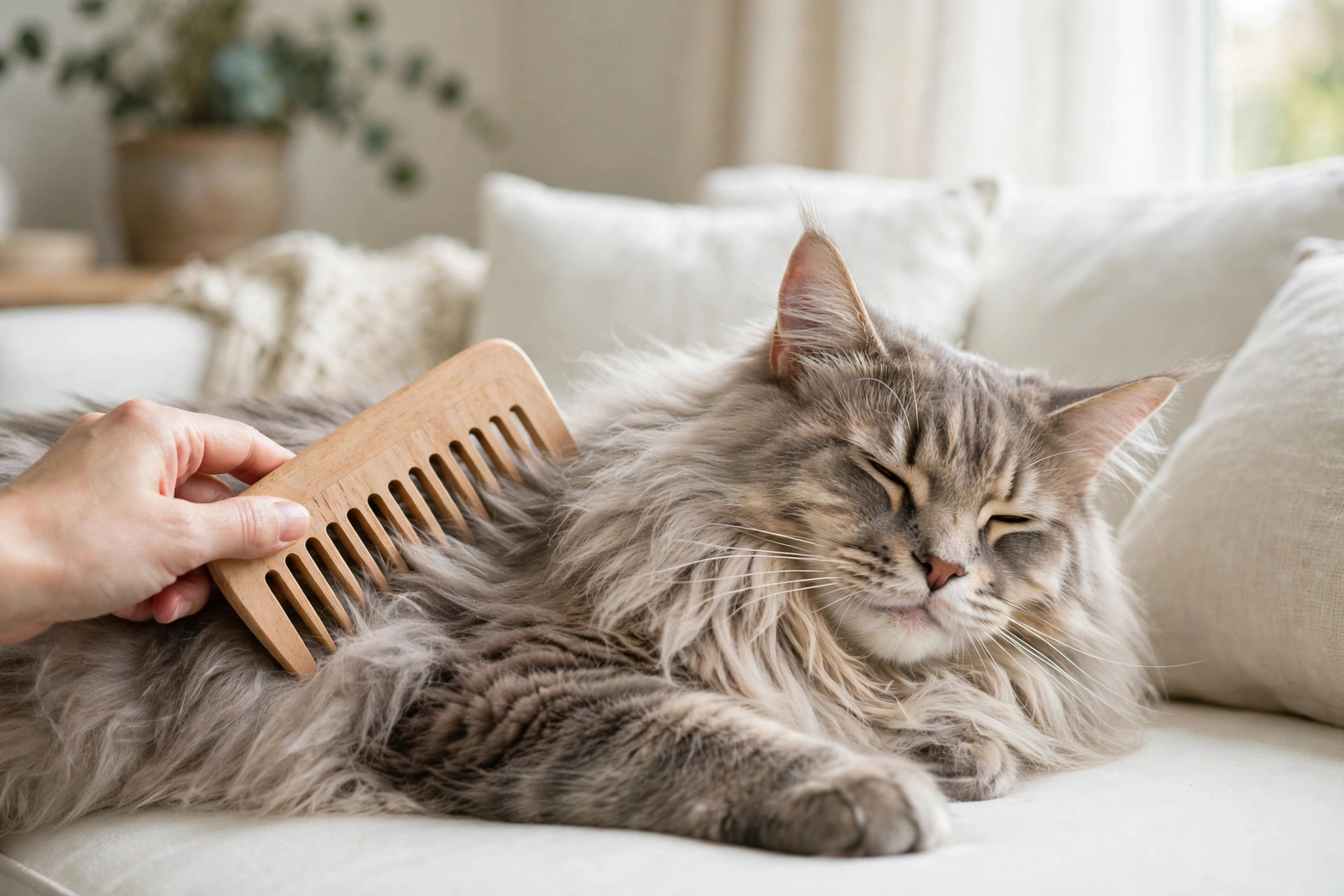
Mats are clumps of tangled fur that form when loose hair is not brushed out. They are common in long-haired cats, in older cats that groom less, and in areas where fur rubs together, such as behind the ears, under the front legs, and around the back legs. Small tangles can often be worked out at home. Tight, large, or painful mats need a professional groomer or a vet.
The direct answer is this: work slowly from the outer edge of the mat inward, hold the base of the mat so you do not pull the skin, and never cut a mat out with household scissors. Cat skin is thin and stretches easily, and it is surprisingly hard to tell where fur ends and skin begins under a dense mat.
Why mats form
Cats shed hair every day. When that loose hair is not removed by grooming or brushing, it tangles with the surrounding coat. Friction makes it worse, which is why mats often appear where the legs meet the body or where a collar rubs. Seasonal shedding, a change in grooming habits, weight gain that makes reaching certain areas harder, and illness can all make matting more likely. If a cat that used to groom well suddenly develops mats, it is worth a vet visit, because a change in grooming can be a sign that something else is going on.
What you need
You do not need much equipment, but the right tools make the job safer and calmer. A wide-tooth metal comb is the main tool for working tangles loose and checking that the fur is clear afterwards. Your fingers are just as important, because they let you feel how tight a mat is before you start. A cat-safe detangling spray or a little cornstarch can help fibres slide apart. Keep treats nearby, and choose a quiet, well-lit place where your cat can sit comfortably.
Do not use household scissors. Even blunt-tipped scissors are risky near a dense mat, because the skin can be pulled up into the mat when you lift it. Professional groomers use clippers for severe mats, and that is the safer choice when a mat cannot be teased apart.
Step by step: removing a small mat
- Let your cat settle. Spend a few minutes stroking them and talking calmly before you begin. A relaxed cat is easier and safer to groom.
- Feel the mat first. Gently lift it and check how close it sits to the skin. If it is tight against the skin, if your cat flinches when you touch it, or if the skin underneath looks red or sore, stop and book a professional.
- Do not bathe the cat first. Wet fur tangles more tightly, so work on dry fur, with detangling spray only if the product is made for cats.
- Hold the base of the mat close to the skin with one hand. This stops the pulling from reaching the skin and makes the process much more comfortable.
- Tease the outer edge apart with your fingers, working in small sections from the outside inward. A pinch of cornstarch can help the fibres separate.
- Once the mat is loosened, use the wide-tooth comb with short, gentle strokes, still holding the base. Work through the area until the comb passes smoothly.
- Check the skin underneath for redness, sores, or irritation once the mat is out, and give your cat a treat and a break.
Work in short sessions. You may only manage one or two mats before your cat has had enough, and that is fine. Forcing the job in one sitting stresses the cat and increases the chance of a mistake. Come back later, or the next day, for the rest.
When to stop and get professional help
Stop at home and contact a groomer or vet if any of these apply: the mat is tight against the skin or covers a large area; your cat is in pain, hisses, or tries to bite when you touch it; the skin underneath is red, raw, moist, or broken; the coat is matted all over, sometimes called pelting; or your cat has suddenly stopped grooming. These are not failures. They are the situations where professional tools and experience are genuinely safer.
Severe matting can hide skin problems, and it can also restrict movement and trap moisture against the skin. A professional can remove the mat with clippers, check the skin underneath, and advise on a grooming routine that prevents it from returning.
Preventing mats
Regular brushing is the single most effective prevention. For long-haired cats, a few minutes of brushing several times a week, or daily during heavy shedding, keeps loose hair from tangling. Run your fingers through the common trouble spots once a week: behind the ears, under the front legs, around the back legs, and along the belly. Catching a small tangle early takes seconds; leaving it can turn it into a mat that takes far longer to remove.
Pay attention to changes, too. A cat that suddenly sheds more, grooms less, or develops mats in new places may need a check-up. Grooming is a good moment to notice other things as well, such as lumps, flea dirt, or sore patches, and to act on them early. Our guide to why cats knead is a reminder that grooming time also tells you a lot about how relaxed and comfortable your cat feels.
Frequently asked questions
Can I brush a mat out?
Yes, if it is small and loose. Start with your fingers, then use a wide-tooth comb, working from the outer edge inward and holding the base near the skin.
Should I cut a mat out with scissors?
No. Cat skin is thin and easy to cut under a mat. If a mat cannot be teased apart, a groomer or vet should remove it with clippers.
Does bathing help with mats?
No, bathing usually makes mats tighter. Work on dry fur, and bathe only after the mats are out, if a bath is needed at all.
How often should I brush a long-haired cat?
Several times a week is a good routine, and daily brushing helps during shedding seasons. Short sessions done often work better than one long session.
Patience is the real technique here. Work slowly, hold the base, stop when your cat tells you to stop, and let a professional handle anything tight, large, or painful. Done that way, most small mats come out safely, and regular brushing keeps new ones from forming.