
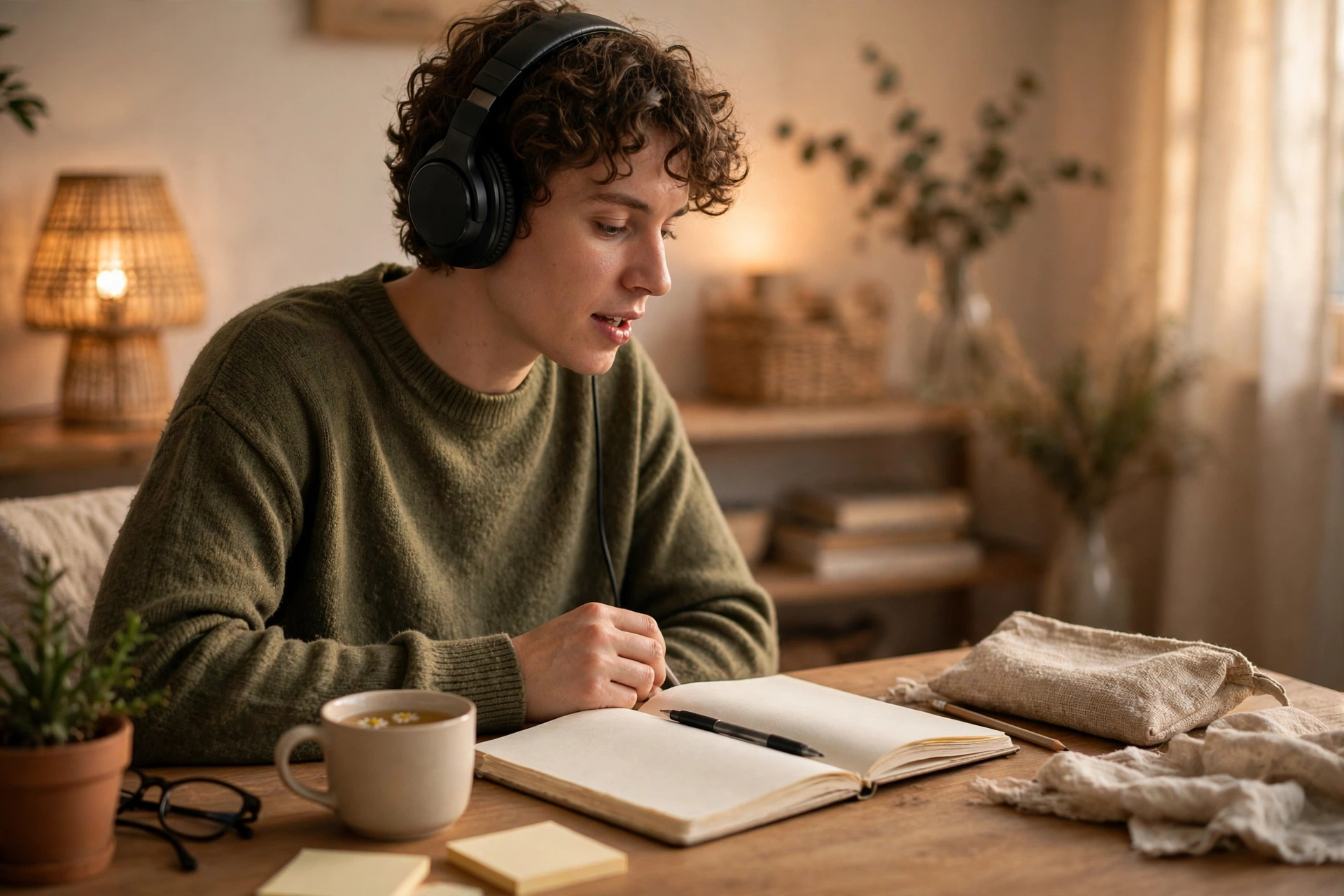
Most people learning Spanish can read and understand far more than they can say. That gap is normal: reading is passive, speaking is active, and the mouth needs practice just as the eyes do. The good news is that speaking practice does not require a trip abroad or a native speaker on call. It requires short, daily, out-loud practice — ideally a little every day rather than a long session once a week.
The short answer
Practice Spanish speaking by speaking every day, even briefly: shadow short audio clips, narrate your own actions in Spanish, record yourself and listen back, and, when you can, talk with a partner or tutor. Fifteen focused minutes a day, built around real sentences you actually need, will move your speaking further than hours of silent study.
Why speaking feels harder than reading
When you read, you can pause, re-read, and guess from context. When you speak, you must recall words, build a sentence, and pronounce it, all at once and in real time. That is why learners often freeze: not because they know nothing, but because they have never practised retrieving words under time pressure. The cure is retrieval practice in small doses — saying things aloud, making mistakes, and correcting them — until the common patterns become automatic.
A useful mindset helps here. Speaking practice is not a performance. It is training. Mistakes are the training itself: each correction teaches your brain a pattern it will recall more easily next time. Waiting until you feel ready is the one strategy that reliably fails, because readiness comes from practice, not before it.
A 15-minute daily routine
A short routine you actually do beats a perfect routine you skip. Try this structure and adjust the timings to your level:
First, warm up for two minutes. Say the alphabet, numbers, days of the week, and a few greetings aloud. This loosens pronunciation and shifts your brain into Spanish mode.
Second, shadow for five minutes. Play a short clip of clear Spanish — a podcast sentence, a news headline, a line from a show — pause after a few seconds, and repeat it immediately, copying the rhythm and melody as closely as you can. Then play it again and repeat once more. Shadowing trains your ear and mouth together, which is exactly what real conversation demands.
Third, make it yours for five minutes. Take a sentence from the clip and change one part: the person, the time, or the place. “Ayer fui al cine” becomes “Mañana voy al cine”; “Quiero comer” becomes “¿Quieres comer?” This turns copying into real sentence-building, and it teaches you how Spanish changes with small adjustments.
Fourth, self-talk for two minutes. Describe what you are doing right now, aloud, in Spanish: what you are cooking, what you will do next, what the weather is like. It will feel strange at first, and it works precisely because it forces you to use everyday vocabulary without a script.
Finally, record for one minute. Record yourself saying a few sentences, then listen back. You will hear pronunciation issues you cannot hear while speaking, and you will also hear progress over weeks that daily practice hides. Keep a few old recordings; comparing them is the most honest measure of improvement.
Practising with no partner
Having no Spanish-speaking partner is a common obstacle, not a dead end. Self-talk, shadowing, and recording cover most of the mechanics of speaking. Reading aloud also helps: read a short paragraph, a dialogue, or your own journal entry aloud, focusing on smooth delivery rather than speed. Singing along to Spanish songs is another useful tool, because songs teach rhythm, linking, and natural phrasing in a memorable form.
Voice typing in Spanish on your phone is a quiet bonus. If the phone understands what you said, your pronunciation was clear enough; if it transcribes something else, you have found a sound to practise. Language apps with speaking exercises can add structure, but they work best as a supplement to real sentences you say aloud, not as a replacement for them.
Finding real conversation when you are ready
Solo practice builds the engine; conversation teaches you to drive it. When you feel able to hold a simple exchange, look for a language exchange partner — someone learning your language while you learn theirs — or a tutor for short, regular sessions. Even one conversation a week changes solo practice, because it reveals which words you actually need and which grammar you keep avoiding.
Joining a group, online or local, adds variety: different accents, speeds, and topics. Do not wait for perfect Spanish to join. Most speakers appreciate the effort, correct gently, and slow down when asked. A simple phrase like “¿Puedes hablar más despacio, por favor?” — can you speak more slowly, please? — is one of the most useful sentences a learner can own.
Building Spanish into the day
Immersion at home does not mean pretending you live in Madrid. It means giving Spanish a few small, repeated slots in your existing day. Label a handful of objects with their Spanish names and articles, and say a sentence about each as you pass it. Cook from a Spanish recipe, follow a short Spanish weather report, or watch a show with Spanish audio and Spanish subtitles so sound and text reinforce each other.
Keep a tiny Spanish journal: two or three true sentences about your day. Writing feeds speaking, because sentences you have written are easier to say, and the journal gives you ready-made topics for your next conversation. Change the material when it stops demanding attention — familiarity is comfortable, but new material is what forces growth.
Common mistakes to avoid
First, only studying silently. Reading and listening are essential, but they do not train the mouth. If your study has no out-loud component, speaking will always lag.
Second, memorising long word lists without sentences. Words are easier to recall inside a sentence you have actually said. Learn phrases, not isolated words, wherever possible.
Third, practising only when you feel confident. Confidence follows repetition, not the other way round. Short daily practice, even on tired days, keeps the habit alive.
Fourth, speaking too fast too soon. Speed without clarity helps no one. Slow, clear, well-pronounced Spanish is easier for listeners and gives you time to think ahead to the next word.
FAQs
How long should I practice Spanish speaking each day?
Fifteen focused minutes a day is a strong start, and it is far better than an occasional long session. As the habit settles, you can extend the routine or add a second short session.
Can I learn to speak Spanish without a partner?
You can build a great deal of speaking skill alone through shadowing, self-talk, reading aloud, and recording. A partner or tutor later adds real conversation skills, but a lack of one is not a reason to stay silent.
What should I do when I get stuck mid-sentence?
Pause, simplify, and keep going. Use a simpler word, describe the word you cannot recall, or ask how to say it. In real conversation, recovering gracefully matters more than finding the perfect word.
How do I improve my Spanish pronunciation?
Shadow short, clear audio, record yourself, and compare. Focus on vowel clarity and sentence melody before speed, and use voice typing as a quick check on whether you are understood.
Bottom line
Speaking Spanish improves the same way any skill does: by doing it, briefly and often, with feedback. Shadow a little, say your own sentences, record yourself, and talk with real people when you can. Fifteen minutes a day, kept up for months, will take you further than waiting for the perfect moment to start talking.
Related reading: how to make your handwriting better; soft skills meaning; Career & Skills
Sources: Fluent in 3 Months guide to Spanish immersion at home; Inklingo guide to practising Spanish with no one to talk to