
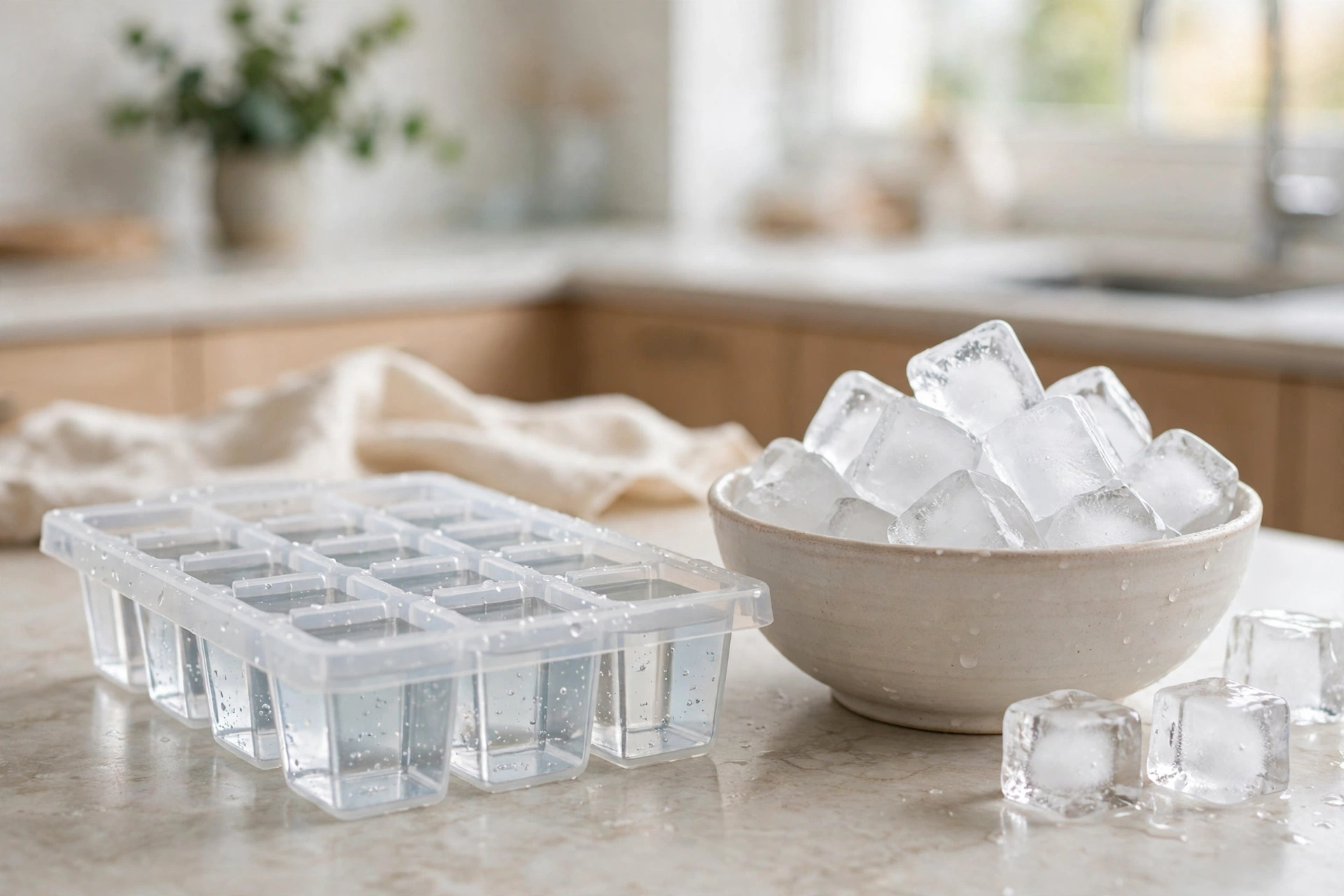
You fill a tray, slide it into the freezer, and then wonder when it will actually be ready. The answer is reassuringly simple for a standard tray, and usefully different for large cubes, deep containers, and automatic ice makers. Knowing the usual times — and what changes them — means you can plan ahead instead of checking the tray every half hour.
The short answer
In a standard home freezer set to 0°F (-18°C), a typical tray of ice cubes takes about 3 to 4 hours to freeze solid. Smaller or shallow cubes can be ready in 2 to 3 hours, while large cubes or deep silicone moulds may need 4 to 6 hours. Automatic ice makers, once running steadily, usually produce a batch every 90 minutes to 3 hours, though the first batch in a new or newly restarted freezer can take much longer.
What freezing actually involves
Water freezes at 32°F (0°C) under normal conditions, but reaching that temperature is only the first step. The freezer must then remove additional heat — the latent heat of fusion — while the water changes from liquid to solid. That is why a tray can feel cold long before it is fully frozen: the surface may be icy while the centre is still liquid.
This also explains why size matters so much. Smaller pieces have more surface area relative to their volume, so cold air can remove heat from them faster. A shallow tray freezes faster than a deep container holding the same amount of water, and a single large block takes far longer than a tray of small cubes.
Times by method and cube size
For a standard plastic tray filled with room-temperature water in a freezer already at 0°F (-18°C), expect 3 to 4 hours. The same tray filled with cold tap water, or pre-chilled in the fridge, may finish closer to 2 to 3 hours. Very small or shallow cubes can be solid in as little as 1 to 2 hours in a cold, well-circulated freezer.
Large cubes, typically around two inches across, need more time — often 4 to 6 hours — because the centre is further from the cold surface. Deep containers and large blocks are slower still, sometimes needing 8 to 12 hours or overnight. If you need a large block for a punch bowl or a cooler, start it the day before.
Automatic ice makers work differently. Once the freezer compartment is stable at its target temperature, a typical maker completes a cycle in about 90 minutes to 3 hours, producing a small batch each time. When a freezer is brand new, or an ice maker has just been switched on, the first batch can take 6 to 12 hours, because the appliance itself must cool down first. Manufacturers often advise discarding the first few batches to flush the water line.
Five factors that change freezing time
First, freezer temperature. The colder the freezer, the faster the freeze, up to a point. A freezer set to 0°F (-18°C) is the usual recommendation for safe food storage and a good baseline for ice. A warmer freezer will freeze more slowly, and a freezer that is opened constantly struggles to stay cold.
Second, starting water temperature. Cold water starts closer to freezing, so it generally freezes faster than hot water. The well-known Mpemba effect — where hot water sometimes freezes first under particular conditions — is real in experiments but inconsistent, so it is not a reliable shortcut. For everyday ice, cold or room-temperature water is the sensible choice.
Third, volume and container. More water takes longer, and the container matters: thin metal trays conduct cold faster than thick plastic or deep silicone moulds. Spreading water across several shallow trays beats filling one deep container.
Fourth, air circulation. A tray tucked behind a wall of frozen food, or a freezer packed so tightly that air cannot move, freezes more slowly. Leave a little space around the tray and avoid blocking vents.
Fifth, door openings. Every opening lets warm air in and forces the freezer to work again. If you need ice by a certain time, fill the tray, close the door, and resist checking it repeatedly — each check adds time.
How to freeze ice faster
If you need ice sooner, use the smallest tray you have, fill it with cold water, and place it where air circulates freely, away from warm items just put into the freezer. Setting the freezer to its coldest setting for a few hours can help, though you should return it to its normal setting afterwards. Making ice in advance and storing finished cubes in a bag frees the tray for the next batch, which is the simplest way to build up a supply.
For clearer ice, the trick is directional freezing: freeze water slowly from one direction, usually from the top down, so air bubbles and impurities are pushed to one end rather than trapped throughout. A small insulated container with the top open, frozen overnight, then trimmed, gives clearer cubes than a standard tray, though it takes longer. For most drinks, ordinary cubes are perfectly fine, and clarity is a bonus rather than a necessity.
Troubleshooting slow freezing
If ice consistently takes far longer than expected, check the basics first. Is the freezer actually at 0°F (-18°C) or below? A thermometer left in the freezer for a few hours gives a more honest answer than the dial. Is the door sealing properly? A worn seal lets warm air in continuously. Is the freezer overstuffed, or are vents blocked? And is the tray sitting in a warm spot, such as near the door where temperature swings are largest?
A brand-new freezer needs about a day to reach its target temperature before it freezes reliably, so a slow first batch is normal, not a fault. If the freezer cannot hold temperature, food safety is also affected, and the appliance needs attention rather than a new tray.
Storing and using ice well
Once cubes are solid, tip them into a sealed bag or container so the tray can be refilled and the cubes do not absorb freezer odours. Ice stored uncovered for weeks can taste stale, so use older ice first and refresh the supply regularly. When serving, remember that larger cubes melt more slowly and dilute drinks less, which is why they suit slow-sipped drinks, while small cubes chill a drink quickly and suit pitchers and coolers.
FAQs
How long do ice cubes take to freeze in a normal freezer?
About 3 to 4 hours for a standard tray at 0°F (-18°C). Smaller cubes may take 2 to 3 hours, and large cubes 4 to 6 hours.
Does hot water freeze faster than cold water?
Generally no, for everyday purposes. Cold water usually freezes faster, and the hot-water-first effect seen in some experiments is inconsistent and not a reliable method.
Why is my ice taking so long to freeze?
Common causes are a freezer warmer than 0°F (-18°C), a door seal problem, blocked air circulation, a very full freezer, or frequent door openings. Check temperature and airflow first.
How can I make ice cubes faster?
Use small, shallow trays, cold water, and a spot with good air circulation, keep the door closed, and make batches in advance so finished ice is already stored when you need it.
Bottom line
Plan on 3 to 4 hours for a standard tray, less for small cubes, more for large ones, and overnight for a big block. Keep the freezer at 0°F (-18°C), use cold water in a shallow tray, leave room for air to circulate, and keep the door shut. With those basics, ice becomes something you make in advance without thinking about it, rather than something you wait for.
Related reading: how long do cooked eggs last in the fridge; how long can you keep rotisserie chicken in the fridge; Cooking & Kitchen