
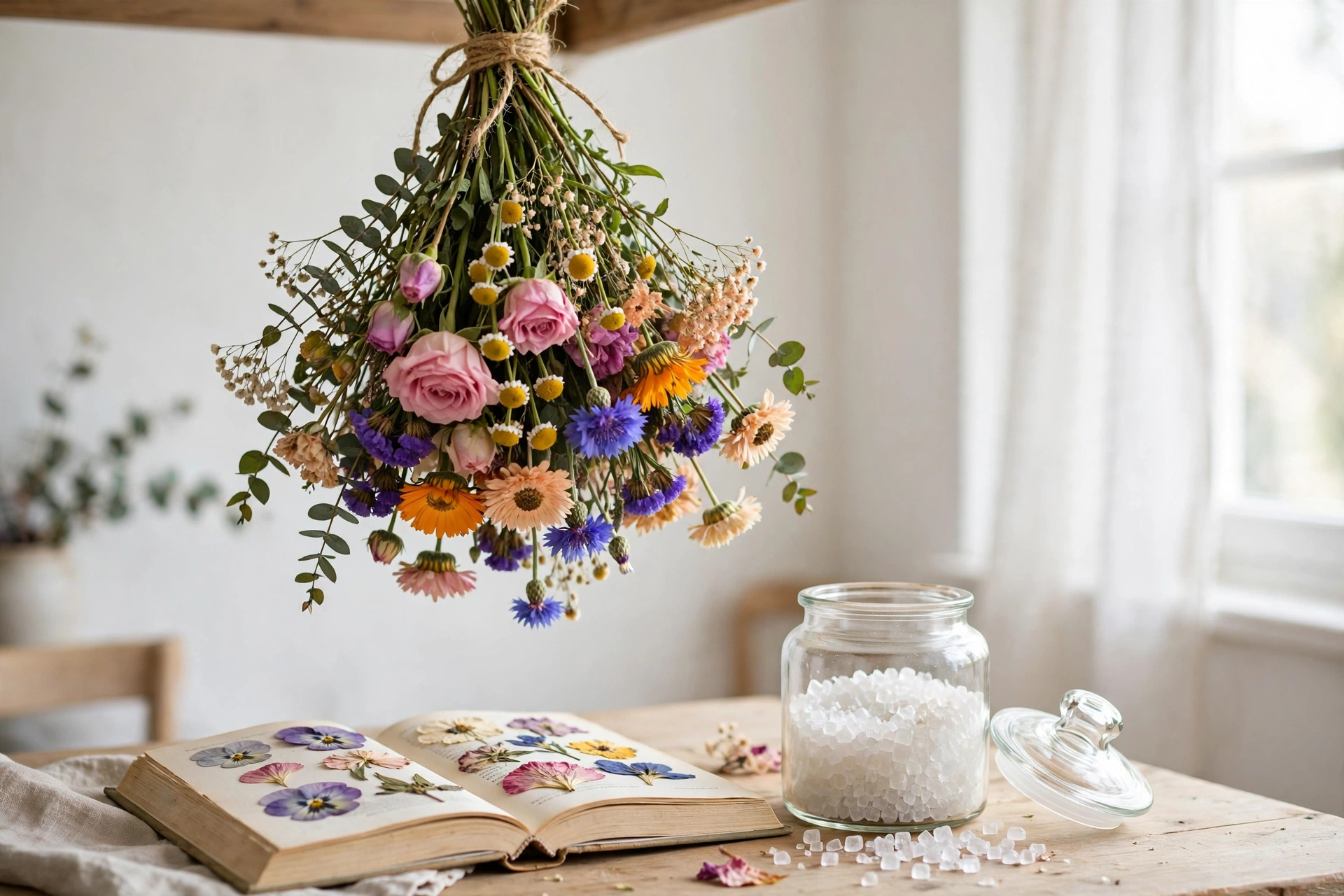
A bouquet from a wedding, a first bunch from your own garden, or a single stem that meant something deserves better than the bin. Preserving flowers is really about removing moisture slowly while holding the shape, so the petals do not rot, shrivel, or lose all their colour. Different methods suit different flowers and different uses, and choosing the right one at the start saves disappointment later.
The short answer is this: for a whole bouquet, hang it upside down to air-dry in a cool, dark, dry place. For flat art and cards, press flowers between absorbent paper under weight. For shape and colour, bury blooms in silica gel. For foliage and some sturdy flowers, glycerin keeps them soft and life-like. Resin is for display pieces made from already-dried flowers. Start with fresh, dry blooms, and keep the finished flowers out of sunlight and damp.
Before you start: pick the right flowers
Use flowers at their peak — fully open but not yet fading, with no brown edges or mould. Remove damaged petals and strip leaves from the lower stems for air-drying. Work with dry flowers: wet petals pressed or buried will mould. Some flowers preserve far better than others. Roses, lavender, statice, baby’s breath, strawflowers, and most small, sturdy blooms dry well. Large, fleshy flowers such as tulips and lilies are harder to air-dry without losing shape, and they usually do better in silica gel or as pressed petals.
Method 1: Air-drying (best for bouquets)
Air-drying is the simplest method and the best for whole bouquets. Strip the lower leaves, group stems of the same type in small bunches of five or six, and tie them with string or an elastic band. Hang them upside down from a hook or hanger in a cool, dry, dark place with good airflow — a spare room, a garage, or a cupboard with the door ajar. Darkness matters: sunlight fades colour quickly. Leave them for one to three weeks, until the petals feel papery and rustle when touched. A light spray of floral sealant or hairspray can reduce shedding, though it does not truly preserve the flower on its own. Air-dried flowers keep their three-dimensional shape better than pressed ones, but they shrink slightly and colours darken. They are ideal for vases, wreaths, and dried arrangements, and they need gentle handling afterwards.
Method 2: Pressing (best for flat art)
Pressing flattens flowers completely, which makes it perfect for framed art, cards, bookmarks, and resin jewellery made from petals. Place a flower face-down between two sheets of absorbent paper, such as blotting paper or plain newspaper, inside a heavy book or a flower press. Change the paper every few days at first, so trapped moisture does not cause mould. Leave the flowers for two to four weeks until fully dry and papery. Handle them with tweezers or a light touch: pressed flowers are beautiful and brittle. Flat, thin flowers press best — pansies, violets, daisies, ferns, and small wildflowers. Thick flowers can be pressed in halves, or with petals separated and reassembled later. Pressed flowers fade in sunlight, so frame them behind glass and hang them away from direct sun.
Method 3: Silica gel (best for shape and colour)
Silica gel is the method that keeps flowers looking closest to fresh. Pour a layer of silica gel crystals into an airtight container, place the flower on top, and gently pour more gel around and over it, supporting the petals so they are not crushed. Seal the container and leave it undisturbed for several days to a week, depending on flower size. Lift the flower out carefully, brush off loose gel with a soft brush, and seal it with a light spray if you like. Silica gel works especially well for roses, peonies, dahlias, and other structured blooms that lose shape when air-dried. The crystals can be reused after drying them in the oven as the packet directs. The downside is cost and fragility: silica-dried flowers are delicate, and the gel must be kept dry between uses.
Method 4: Borax and cornmeal (a cheaper drying mix)
A mixture of borax and cornmeal, or borax alone, works on the same principle as silica gel: it draws moisture out while supporting the shape. Bury the flower head in the mix in an airtight container, seal it, and leave it for one to two weeks. This method suits thin-petalled flowers such as roses and tulips, and it costs far less than silica gel. Label the container clearly, keep the mixture away from food, children, and pets, and wash your hands after handling it — borax is not a food product and should not be treated as one.
Method 5: Glycerin (best for foliage and softness)
Glycerin preservation is different: instead of drying the plant out, it replaces some of the water in the stems and leaves with glycerin, so foliage stays soft, flexible, and life-like for months. Mix one part glycerin with two parts water, crush or split the lower stem ends, and stand the stems in the solution, topping it up as it is absorbed. After one to three weeks, when the leaves feel soft and slightly oily, remove them and air-dry briefly. Glycerin works well for eucalyptus, magnolia leaves, beech, and other foliage, and for some sturdy flowers, but colours darken and it is not the best choice for delicate petals. Keep glycerin-treated plants away from children and pets, as they can be harmful if eaten.
Keeping cut flowers longer is not the same thing
It is worth separating two goals. Keeping cut flowers alive in a vase — fresh water, a clean vase, trimmed stems, flower food, and water changed every couple of days — extends life by days or a week. Preserving flowers, by contrast, stops them at a moment and keeps them for months or years, but they will never be fresh again. If you want a bouquet to last for an event, use vase care. If you want to keep it afterwards, start preserving it while it is still fresh, not after it has already wilted in the vase.
Displaying and storing preserved flowers
Dried and pressed flowers last longest in a cool, dry place out of direct sunlight. Dust them gently with a soft brush or a hair dryer on a cool, low setting. Keep them away from damp rooms and kitchens, where steam reintroduces moisture, and away from places where they will be knocked often. A glass cloche, a frame, or a vase in a quiet corner protects them far better than an open shelf in a busy hallway. If a flower starts to smell musty or shows mould, remove it before it affects its neighbours.
Which method should you choose?
Choose air-drying for bouquets and rustic arrangements, pressing for flat art, silica gel for a special bloom you want to look fresh, borax mix for a budget version of silica, and glycerin for foliage and soft, life-like leaves. If you are unsure, try a small test flower first: a single stem dried by your chosen method tells you more about colour and shape than any guide can. And if a flower matters to you, preserve it sooner rather than later — a week in a vase is a week of fading you cannot undo.
FAQs
How long do preserved flowers last?
In a dry, dark place, air-dried and silica-dried flowers can last a year or more, and pressed flowers in a frame can last for years. Sunlight, damp, and handling shorten their life.
Can I preserve flowers in resin while they are fresh?
No. Flowers must be fully dried first, or moisture trapped in resin will cause mould and clouding. Dry them by silica gel or pressing, then embed them in resin.
Why did my dried flowers go mouldy?
They were probably damp when stored, pressed with wet paper, or kept in a humid place. Start with dry flowers, change pressing paper early, and store finished flowers somewhere dry.
Do preserved flowers keep their scent?
Mostly, no. Drying fades scent along with moisture. Lavender and some herbs keep more scent than roses or peonies, but preserved flowers are kept for looks, not fragrance.
Bottom line
Hang bouquets to air-dry, press flat flowers for art, bury special blooms in silica gel, and use glycerin for soft foliage. Start fresh, keep them dry and out of the sun, and a bouquet that would have lasted a week can last for years.
Related reading: How to Revive a Peace Lily and the Home & Garden category.
Sources: Interflora — How to Dry Flowers; 20 Mule Team — Preserve Flowers Naturally.