
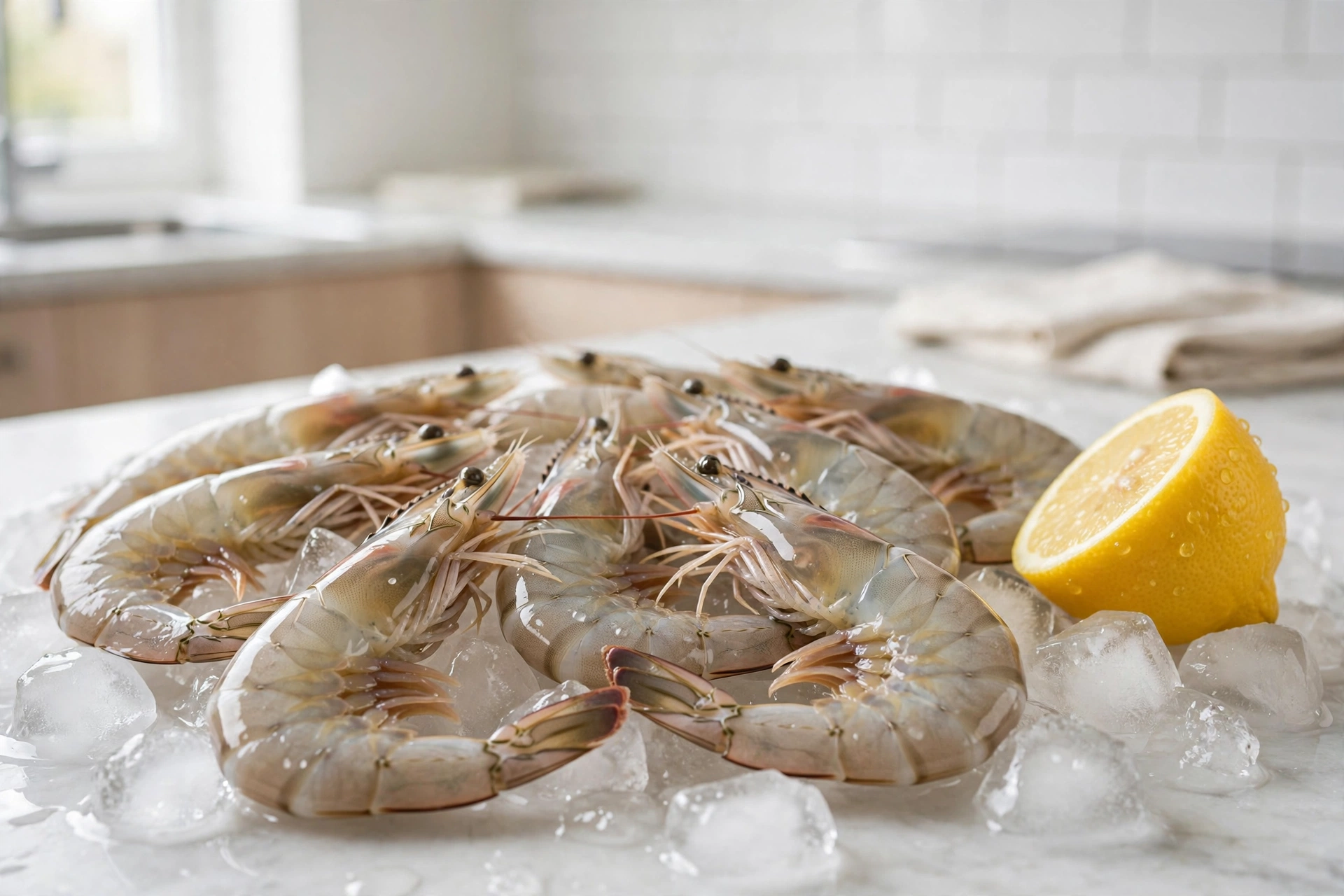
Shrimp spoils faster than most foods in the fridge, and it gives clear warnings when it turns. The trouble is that people often check only one sign, usually colour, and miss the more reliable ones. Learning how to tell if shrimp is bad means using three senses together: smell, touch, and sight, in that order. If any one of them is clearly off, the safe choice is to throw the shrimp away. Cooking does not rescue spoiled shrimp, and rinsing does not wash away the problem.
Start with the simplest rule: when in doubt, throw it out. Shrimp is not expensive enough to risk a night of food poisoning, and spoilage bacteria can produce compounds that heat does not destroy. No recipe, marinade, or strong sauce makes bad shrimp safe.
Smell: the most reliable test
Fresh shrimp has almost no smell, or only a faint, clean, sea-like scent. That is the baseline to remember. Spoiled shrimp smells sharp and unpleasant: ammonia-like, sour, strongly fishy, or like bleach. Ammonia is the clearest warning of all. Fresh seafood never smells of ammonia, so if you catch that note, the shrimp is done, even if it still looks acceptable.
Smell the shrimp as soon as you open the package, before you rinse it. Rinsing can temporarily mask a mild odour, which is exactly why you should not rinse first and then decide. Frozen shrimp should also have very little smell when thawed. If an ammonia or sour note appears as frozen shrimp thaws, discard it. A strong smell that was not there when you bought it means the cold chain broke somewhere, or the shrimp sat too long.
Touch: firm, not slimy
Fresh raw shrimp feels firm and slightly springy. Press it gently and it should hold its shape and bounce back a little. Spoiled shrimp feels slimy, sticky, or mushy, and the flesh may fall apart or feel soft and flaccid. A slimy coating is bacterial buildup on the surface, and it is one of the most reliable signs of spoilage. If slime returns after rinsing, that confirms it. Do not try to rinse slime away and cook the shrimp anyway.
The shell gives useful clues too. On fresh shrimp, the shell sits tight against the flesh. On spoiled shrimp, the shell may feel loose, soft, or start to separate easily before cooking. That looseness reflects the breakdown of the flesh underneath. Cooked shrimp should also stay firm and springy. If cooked shrimp turns soft, mushy, or slimy in the fridge, it has gone bad, even if it was cooked properly in the first place.
Look: colour, sheen and spots
Fresh raw shrimp is translucent, with a clean, pearly sheen. The exact tint varies by species: some are greyish, some pinkish, some slightly orange. What matters is that the colour is even and the surface looks moist and fresh, not dull or faded. Spoiled shrimp loses that sheen and turns dull, opaque, yellowish, or grey. A generally faded, tired appearance, especially combined with a bad smell or slime, is a clear sign to discard it.
Black spots need a more careful reading, because they are often misunderstood. Black spots on the shell, known as melanosis, are a natural enzymatic browning that happens when shrimp is exposed to air after harvest. On their own, with firm flesh and no bad smell, they are generally harmless, although they show the shrimp is older. The situation changes if black spots come with a foul smell, slime, or mushy flesh. Then the shrimp is spoiled, and the spots are part of a wider picture, not the sole cause. If black spots extend deep into the meat, or the flesh under a spot feels mushy or sticky, throw it away.
Mould is a different matter entirely. Any visible mould on shrimp or inside its package means discard it at once. Mould shows the shrimp has sat far too long, and rinsing will not make it safe.
Raw, cooked, frozen: different clocks
Storage times are part of the freshness check, because shrimp can look acceptable just past its safe window. Raw shrimp keeps for only about one to two days in the fridge. Cooked shrimp keeps a little longer, about two to three days, stored in a covered container. If you are unsure how long shrimp has been in the fridge, the date matters more than appearance. Do not taste a small piece to test it. Tasting spoiled seafood is not a safe test.
Frozen shrimp lasts much longer, usually several months in a sealed freezer bag, but quality declines over time, and freezer burn can make texture dry and tough. Thaw shrimp safely in the fridge, never on the counter at room temperature, and cook thawed shrimp within about a day. Refreezing thawed shrimp is not recommended, as each thaw gives bacteria more time to grow and damages texture.
When buying shrimp, check the same three signs. Fresh shrimp at a counter should smell clean, look translucent and glossy, and sit on ice. Avoid shrimp that smells strongly even through the display, looks dull or dried at the edges, or sits in a pool of cloudy liquid. If shrimp is sold pre-packaged, check the use-by date and make sure the package is cold and intact. Bright pink raw shrimp is also a warning sign, as raw shrimp is usually greyish or translucent before cooking. Shrimp that is already vividly pink may have been previously cooked or treated, and it deserves a closer check.
What to do if you are unsure
Use the three-test rule. Smell first: ammonia, sour, or strongly fishy means discard. Touch second: slimy, sticky, or mushy means discard. Look third: dull, grey, yellow, or faded, especially with either of the first two signs, means discard. Any single strong warning is enough. You do not need all three to agree before throwing shrimp away.
If you have already eaten shrimp and then worry it was off, watch for symptoms such as nausea, vomiting, stomach cramps, or diarrhoea, which can appear within hours. Drink water, rest, and seek medical advice if symptoms are severe, if you cannot keep fluids down, or if they last more than a day. This is general information, not medical advice, and a clinician can judge your situation properly.
FAQs
Can I cook bad shrimp to make it safe? No. Cooking kills some bacteria, but spoilage can leave behind heat-stable compounds, and the texture and smell will still be wrong. Discard spoiled shrimp.
Are black spots on shrimp dangerous? Black spots alone, called melanosis, are usually harmless shell browning. Discard the shrimp if spots come with a bad smell, slime, or mushy flesh.
How long does raw shrimp last in the fridge? About one to two days. Cooked shrimp lasts about two to three days. When unsure, use the date, not appearance alone.
Should I rinse shrimp before checking it? No. Check smell and texture before rinsing, because rinsing can mask odour and slime temporarily.
Fresh shrimp is quiet: little smell, firm flesh, and a clean, translucent shine. Anything loud, slimy, or dull is the shrimp telling you it is past its best, and the safest answer is to let it go.
Related reading: how to wash apples; how to disinfect cutting boards; is pasta healthy; Food & Nutrition archive. Sources: Chefs Resource on knowing if shrimp is bad; Fango guide to telling if shrimp is bad.